

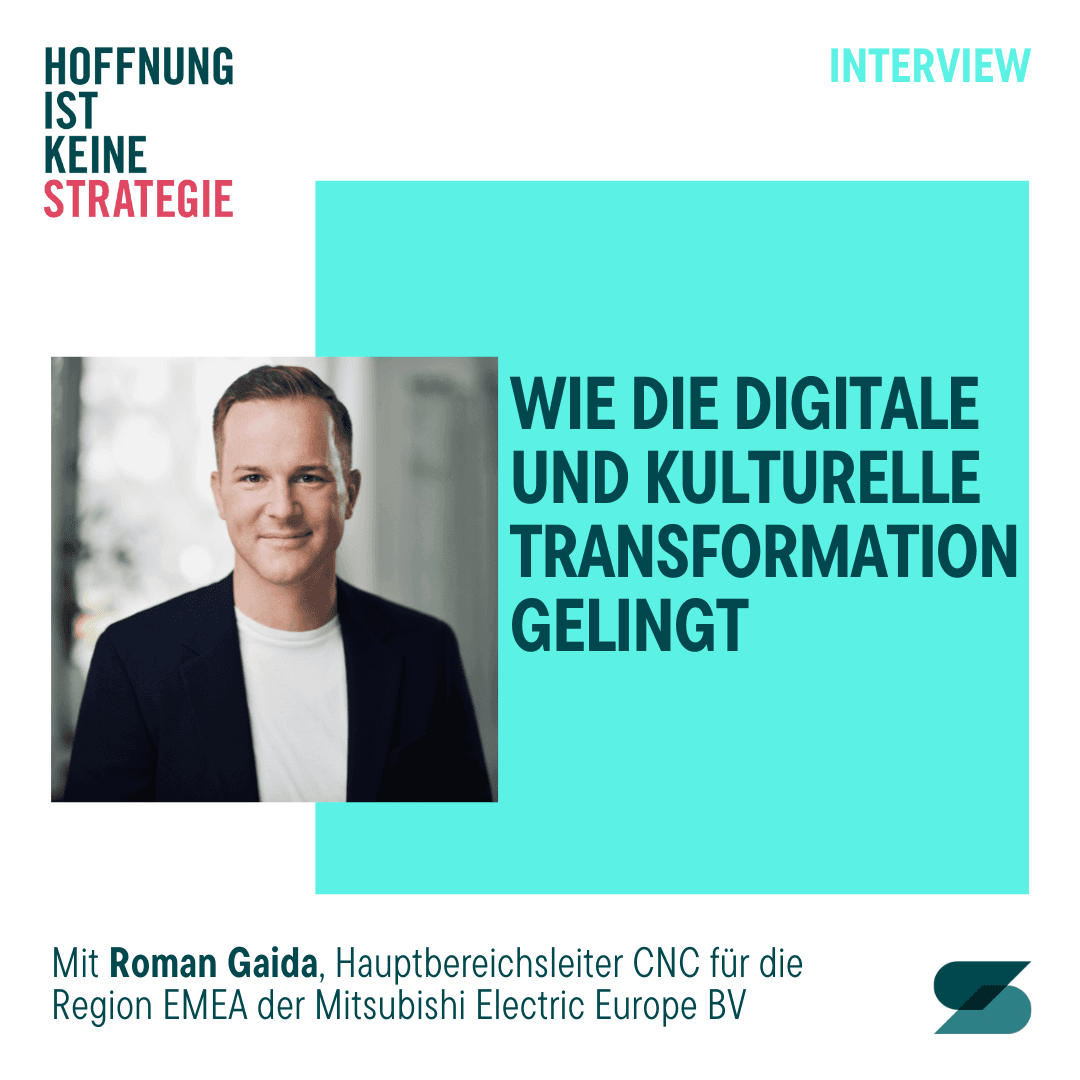
38# Business unit strategy: how to pull off digital and cultural transformation
This episode was recorded in German.
In 2023, companies still have to work hard to keep pace with technological change and adapt their processes and business models accordingly. Over the years, digital transformation has become an unmissable buzzword in the corporate world. One such company is Mitsubishi Electric Europe, a global leader in the CNC industry. Roman Gaida, today Head of Division EMEA, joined Mitsubishi in 2017 with his sleeves rolled up, ready to set long overdue changes in motion.
In this episode, Roman Gaida and Christian Underwood take us along on the journey of digital and cultural transformation, from the goals and challenges to the strategies that worked. Together they look at how Roman tackled the technical and organizational sides of the transformation and how he managed to bring change, innovation and people into alignment.
Ein kurzer Überblick: Wie kam Roman Gaida zu Mitsubishi Electric Europe und was macht das UnternehmenBeyond the main topic of this podcast episode, driving fundamental change in companies stuck in their ways, Roman's own career shows that it is never too late for a deep transformation. After six years of shift work as a cutting machine operator, he trained as a mechanical engineering technician on the side and earned his technical secondary school diploma.
At 27, he began studying industrial engineering at the Baden-Württemberg Cooperative State University and then joined Oerlikon in Switzerland in 2013, where he was responsible for global business development for almost four years. During that time he completed an Executive MBA at RWTH Aachen in cooperation with the University of St. Gallen and attended executive programs at MIT and Stanford. He has also written two and a half books and today co-hosts the successful podcast "Working Dad." The digital transformation at Mitsubishi Electric was meant to be every bit as successful as his own career transformation.
Before we dive in, let's take a step back and look at what Mitsubishi Electric Europe CNC actually offers. The company produces controls, drives and software for machine tools such as turning, milling and grinding machines. It also provides services to customers across Europe, the Middle East and Africa (EMEA).
While Mitsubishi Electric itself operates across a range of industries (automotive, transportation, semiconductors, building management, elevators and robotics), the CNC division specializes in machine tools.
Die Ausgangslage und Zielsetzung des europaweiten Programms zur digitalen Transformation bei Mitsubishi Electric EuropeWhen Roman moved from Oerlikon to his new role as Head of Sales and Marketing in the CNC division at Mitsubishi Electric Europe in 2017, he started out with a sweeping mandate: to roll out a Europe-wide digital transformation program.
But what does digital transformation actually mean in a corporate context? It describes the process of integrating innovative technologies into every part of the business, from everyday workflows to strategic decision-making. It is not just about switching from analog to digital procedures, but also about a fundamental shift in company culture. It allows companies to adapt to changing customer needs and expectations and to optimize their own business processes in order to stay competitive.
The starting point at Mitsubishi Electric CNC, however, was sluggish and shaped by a business unit that had grown organically over decades. Inefficient work processes had crept in, and siloed knowledge left little room for growth. The program's goal was therefore to become more scalable through modernization, to simplify processes and to free up resources for growth.
Zunächst die kulturelle Veränderung anstoßen: Erst das digitale Mindset schaffen und die Mitarbeiter:innen abholenTo address these challenges, Roman initiated a gap analysis across the entire European organization. Every area, from technology to administration, was examined to identify what could be improved. Both KPAX and OPEX management were front and center. Rather than leading with criticism, Roman chose restraint. He took his time, listened to people, worked alongside them in different areas and looked for where change was really needed.
As so often happens, the engineers in the company initially tended to push change forward through new IT tools and digitized processes alone. What got overlooked at first was that this requires a change mindset among employees and that the interfaces between departments need to be connected. In practice, many companies seem to make the mistake of restructuring the org chart first instead of preparing employees for that restructuring. Christian calls this "strategy follows structure."
Roman and Christian talk about how important it is to drive cultural change in the company alongside digital transformation. The conclusion: changing technologies and processes is not enough, employees have to come along. Without the right mindset and the workforce's willingness to change, digital transformation cannot be brought to a successful conclusion.
Den Gegenwind einfangen und einen “Sense of Urgency” schaffenBut if employees are not aware that change is absolutely necessary, progress is slow. In 2017 things could not have been going better for the mechanical engineering industry, so the pushback was clear: why do we need to change at all?
Roman describes how he first had to create a "sense of urgency," in John Kotter's terms, to convince employees that change was necessary. He organized the first town hall meeting in the company's history to make clear to the 80 employees at the site at the time that change was a preventive measure. And that insight still holds today: it is important to train the "change muscle" early and develop strategic foresight. That is the only way to win people over for change and lead the company successfully into a digital future.
"Comparing it to what Uber did to the taxi market and Airbnb to the hotel market, I tried to explain when the right moment for change is. It is not when we are in trouble. Because by then we need to have trained that change muscle already. Not once we need it, you have to do it beforehand." - Roman Gaida
Digitale Transformation beginnt bei den Führungskräften? Durch Coaching und Feedbackkultur den Führungsstil verbessernThe planned digital transformation started at the top, with the leadership team. In joint offsites, the first question was how they themselves wanted to be led. Self-perception was compared with how others saw them, to reveal how these leaders actually lead and how they motivate their people, or demotivate them. After that, they were coached "in secret" for a year.
After a year, an online survey examined how and whether their leadership style had changed and to what extent employees had noticed. The goal was for the leaders to draw their own conclusions from the results about the direction they had taken, so that an organic "sense of urgency" would emerge from the findings. The survey is being repeated now, three years on, to consistently hold up a mirror to the leadership team.
One weak point that surfaced was that leadership had often been treated as an afterthought in the organization. There were also very different ideas about what leadership actually means. As a result, some leaders were released from their roles or moved to other positions within the company, giving them the chance to relearn their leadership skills or find a way out. Roman emphasizes that the point is to handle these changes sensitively in order to keep and develop those people in the company.
Welchen Platz findet das Thema New Work in einer kulturellen und digitalen Transformation?The term New Work has been around since the 1970s and was coined by the social philosopher Frithjof Bergmann. It describes a modern approach to designing work environments and conditions based on self-determination, flexibility and collaboration. Ultimately, it is about breaking up traditional hierarchies and fostering a culture of openness and agility.
By examining leadership, Roman gained access to employees and their needs. When it came to New Work, the digital transformation wasn't just about launching the usual topics like remote work or flexible hours. It was much more about the principle of challenging and supporting people.
Selbstwirksamkeit und Verantwortung: Schlüsselbegriffe für eine positive ArbeitsatmosphäreRoman emphasizes that in the end it wasn't about giving employees a sense of satisfaction, but a sense of self-efficacy. That comes about when employees have the chance to help shape things and take part in decisions, when they're brought along on the journey, when leaders share information transparently, and when they're taken seriously and seen.
But at Mitsubishi Electric CNC, self-efficacy today also comes with responsibility. Employees can't simply complain about a situation, they have to propose how to improve it. This way of working together creates a positive atmosphere in which employees feel their opinions and ideas are heard and that they're able to bring about positive change. And you get there by enabling employees, not just delegating to them. It's also about responsibility and the willingness to step out of your comfort zone, including as a leader. It's about creating a psychologically safe space where open feedback is possible and problems can be discussed.
Technologische Innovationen und kulturelle Anpassungen: Ein neues Gesamtbild des UnternehmensIt's now been five years since Roman initiated and successfully carried out that digital transformation. Today he takes a positive view: the phase of scaling and harvesting has begun. Looking back at the transformation, the sum of all the individual changes creates the new overall picture. For example, they brought a previously outsourced robot service back in-house and introduced remote services that let employees deliver service directly at the customer's site via Google Glasses. They also implemented chatbots to support technical problem-solving and integrated NLP analytics into mentoring programs.
But it wasn't only technological innovations that were introduced, the company's culture and structure were adapted as well. New meeting cultures were established, and even sleep training was offered for leaders. Through Europe-wide mentoring programs and a new innovation and competence center for Europe, the company increased its competitiveness with almost the same headcount. All of these changes and adjustments have allowed the business unit to move faster in the market and bring ideas or products to market more quickly. To achieve a successful transformation, it's sometimes important to take risks and operate at the edge of what's possible for you.
Romans Tip: Wie man eine digitale Transformation erfolgreich anstößtFinally, Roman offers a head start to those business owners who want to launch a digital transformation of their own. His advice: take your time first and don't rush anything. That lets you assess the current situation, get an overview, and spot potential problems. It pays to listen and take the time to understand the needs and requirements of everyone involved before taking action. Listening and observing help you identify what really matters, and that's what secures the success of the transformation process.