

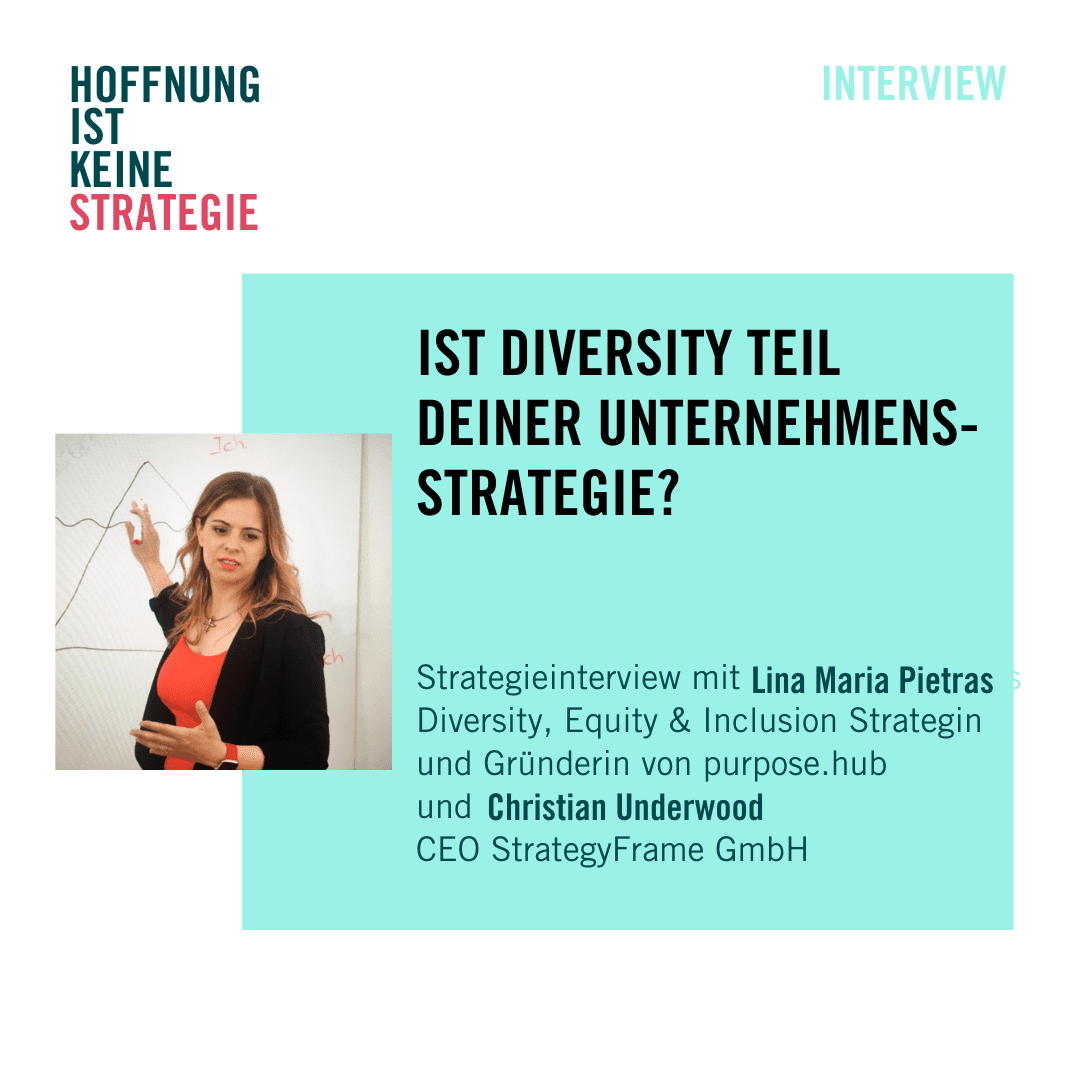
#36 Is diversity part of your corporate strategy?
This episode was recorded in German.
A company that fosters the diversity of its employees is a more successful company. That insight is nothing new, yet the shift toward more diversity, equity & inclusion (DEI) in companies often seems to move slowly. Lina Maria Pietras, certified business leadership coach and DEI manager, knows exactly how to accelerate that kind of change inside organizations. In this episode, Christian Underwood and Lina Maria Pietras discuss what DEI actually means in a business context, and she describes what a company's first steps toward diversity can look like.
"Reminding people that they work with people, and seeing inclusion as a basic right of every human being": that is what drives her wide-ranging work. Born to German and Brazilian parents, she holds a business degree from the Baden-Württemberg Cooperative State University and an MBA from WHU. Today she is a certified business leadership coach and advises corporations and mid-sized companies on diversity, equity & inclusion (DEI) through her own firm, Purpose.Hub. On top of that, she is not only a German Diversity Award winner in the Disability category, she also volunteers for numerous organizations. And she does all of it with 4% vision. Lina has been nearly blind since the age of nine.
Was versteht man unter Diversity, Equity & Inclusion im Unternehmenskontex?Among other roles, Lina works as a DEI manager, responsible for developing and implementing strategies and initiatives that advance diversity, equity and inclusion within a company. But what exactly do these terms mean in a business context?
Diversity means the presence of differences in a given environment. In the workplace, that can mean differences in race, ethnicity, gender, gender identity, sexual orientation, age and socioeconomic class. It can also refer to differences in physical ability, or to something like whether or not someone has children. Equity is the process of ensuring that practices and programs are impartial and fair and offer every individual the same opportunities. Inclusion is the practice of ensuring that people feel a sense of belonging at work. That means every employee feels comfortable and supported by the organization in showing up as their authentic self.
By combining these three elements, DEI becomes a guiding principle that recognizes the value of different voices and highlights inclusivity and employee well-being as central to success. To bring these values to life, companies have to implement programs and initiatives that actively make their offices a more diverse, more equitable and more inclusive place. And that is exactly where Pietras's work begins.
“Je diverser, desto erfolgreicher ein Unternehmen” - wieso dann der langsame Wandel?McKinsey's 2020 study "Diversity Wins: How Inclusion Matters" showed that companies with strong gender and ethnic diversity are more likely to be above-average in profitability. Companies with high gender diversity are 25% more likely, and companies with high ethnic diversity as much as 36% more likely, to outperform financially. These findings are based on data from more than 1,000 companies across 15 countries. So how can it be that business leaders have paid so little attention to diversity so far?
Pietras explains that diversity in top management has been a blind spot, and that its value and productivity gains were simply overlooked. More time in decision-making rounds, longer innovation cycles and deeply rooted beliefs about the existing, homogeneous educational backgrounds stood in the way of fast, productive change and of understanding the value diversity creates. There may also be a lack of understanding or awareness of the benefits diversity brings to decision-making and problem-solving. The lack of diversity in leadership positions may be another reason, since it makes it harder for different perspectives to be heard and acted on. Finally, unconscious bias or general resistance to change within organizations can hold back diversity initiatives.
"People had found the formula, no matter the industry, and then they stayed with it. You had no need at all, and no desire, for anyone to question the universal formula you thought you had found." - Lina Maria Pietras
Unternehmen mit Frauen in den Führungspositionen sind erfolgreicherThe International Organisation of Employers confirmed this in a study. So is this really a conversation about gender rather than diversity in general? The International Organisation of Employers found that two thirds of companies with a mixed executive team increased their profits by up to 15 percent. Pietras stresses that it is important not to limit diversity to gender diversity, but to consider every kind of diversity present in a company.
"In the end I always find it helpful, because you come back to the point and remember that we are all human beings. No matter which label we carry, no matter how many labels we carry." - Lina Maria Pietras
Vielfalt als Erfolgsgarant: Wie Diversität zu mehr Profit führtCompanies with high ethnic and age diversity are also more likely to succeed. Is diversity a success factor? Pietras and Underwood explain that the resulting increase in profit can be traced back to several factors: broader perspectives, higher employee satisfaction, greater appeal to customers, a better reputation and more innovation. A balanced mix of backgrounds and life experiences also leads to more creative solutions. Companies should therefore put more effort into building diversity of background and gender in their leadership teams in order to achieve the best possible results. Pietras then looks ahead and notes how many untapped markets and perspectives are still out there, and how results will shift over the next five years through a "more diverse diversity."
Vorurteile abbauen und ein Bewusstsein für unterschiedliche Distanzen schaffenPrejudices about certain life circumstances or physical limitations break down slowly, especially in a business context. According to Pietras, disability is still far from being widely accepted and embraced in many companies. You can see it in the hesitation to fill leadership positions with people with disabilities. They simply aren't trusted with those roles yet, she says. Diversity and inclusion therefore touch different aspects and functions within a company, and she patiently works through the various steps on the path to a more inclusive organization.
General prejudices also differ widely depending on where a team member's own reality is rooted. Family status and work-life balance, for example, may be far more present for a team with many parents than for a team of young people for whom starting a family is still a long way off. It is important to be aware that there are different distances to cover on the path to an inclusive company, depending on the level of acceptance for each particular topic.
Inklusion durch den richtigen Strategieprozess: Wie Diversität in die Unternehmensstrategie einbezogen wirdOne key element in advancing diversity, equity and inclusion in a company is the right training. One-off training sessions focused on prevention have been shown to have little effect on changing mindsets and behavior. What matters instead is targeting behavioral change specifically and building identification with the breadth of the topic.
A classic, operational training program tied purely to budget does not necessarily produce an inclusive and diverse company. Diversity, equity and inclusion should therefore be built into the strategy process, with the company representatives involved in that process acting as role models and broadening perspectives in the process.
Pietras also says it's important to foster diversity in a team, even if the team's composition can't change overnight. So one key step is to look closely at the obvious differences within your own team and try to understand the factors behind them. That's why Pietras and Underwood are in favor of the occasional argument: it brings to light what's actually going on underneath.
Ist das Thema “Diversity” vielleicht nur Mittel zum Zweck oder Zweck an sich?Both! In the strategy process it's a means to an end, preparing the company for a constantly changing environment, and an end in itself, because it brings more perspectives and ideas into a team and makes better use of each team member's potential.
Pietras also suggests asking owners what the push for DEI means for their own company culture. A more inclusive and diverse culture, for example, is central to countering the shortage of skilled workers and making sure every employee's voice is heard. Factoring DEI into the strategy process is therefore essential, not only for commercial success but for a successful transformation.
“There is no such thing as THE diverse organization. We're never done. There's no fixed point.”
- Lina Maria Pietras
The path to an inclusive company is an experimental one, and there's no set ideal to aim for. That said, she sees more willingness among mid-sized companies to take risks and try new things. They often have fewer resources, which forces them to be more creative, so they're more open to testing changes in behavior. That frequently leads to innovative solutions and more effective execution of diversity strategies.
How can companies get started if they're now asking themselves: how do we improve our diversity?
Pietras recommends a playful approach. One option is to use virtual or in-person cafés to test your assumptions about your colleagues and learn more about their perspectives and backgrounds. Suddenly a sterile job title reveals an unexpected, colorful life behind it, which creates far more understanding and insight into colleagues you may have worked with for years.
Another option is to get a small group together, five people for example, and ask open questions that no résumé or job title can answer. That helps build a better understanding and greater appreciation of the diversity in the team, and makes better use of each team member's potential.
Making the world more inclusive is what drives Lina Maria Pietras every day. She closes with a reminder that, in the end, it comes down to the fact that being human is what unites us.
SHOW NOTES
Donate to the Kinderaugenkrebsstiftung- reference: LINArennt: