

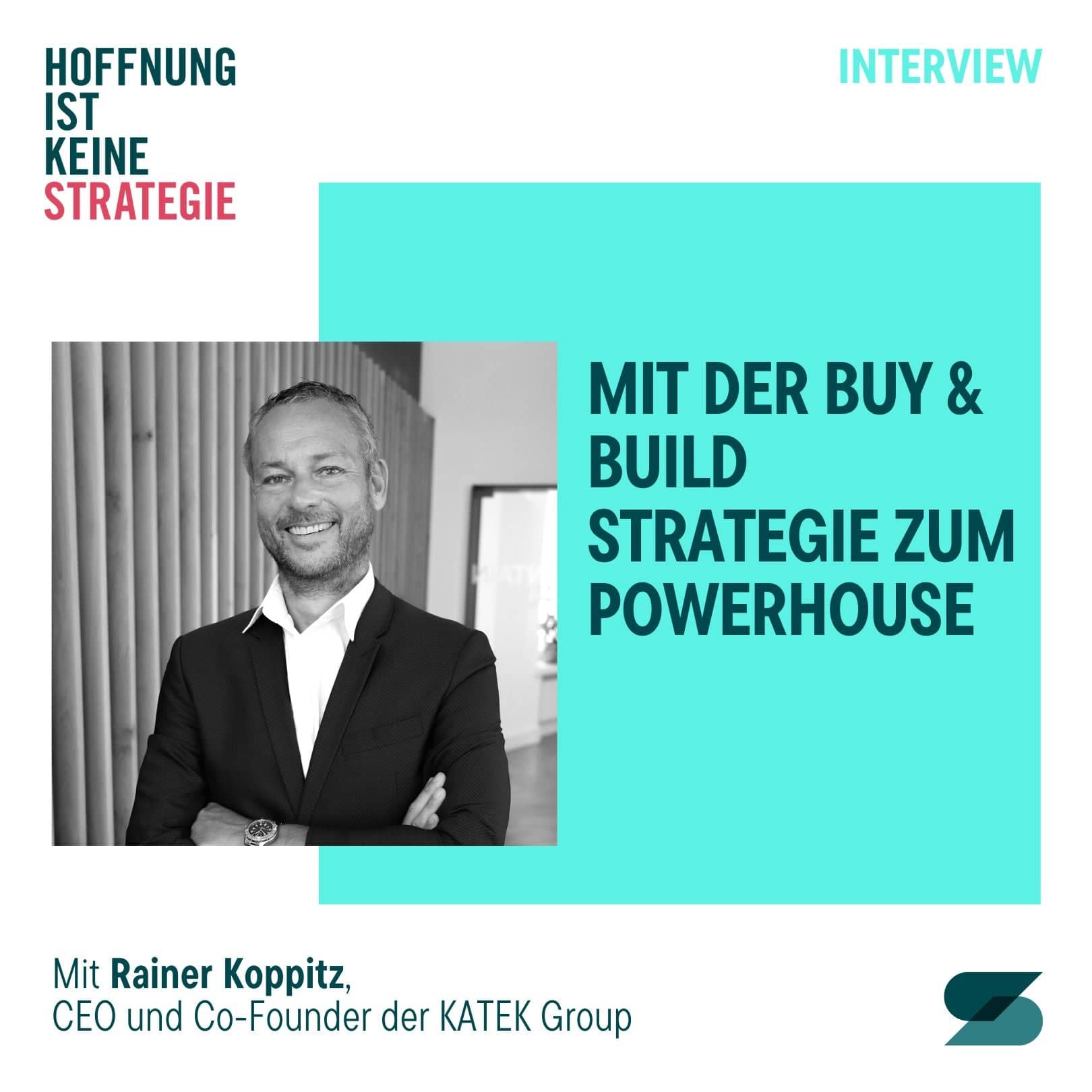
#29 Becoming a powerhouse with a buy & build strategy
This episode was recorded in German.
Strategy interview with Rainer Koppitz, CEO and co-founder of KATEK Group
Mit den drei Stufen der Buy & Build Strategie können Unternehmen gezielt zum großen Erfolg geführt werden. Jetzt lesen, was genau es dafür braucht!Let this episode inspire you to think big, with a truly unique startup success story. Rainer Koppitz, CEO & co-founder of KATEK Group, describes the rapid rise of the electronics company he co-founded: the early days, the growth, and the leading role it plays in the industry today.
KATEK brings together the champions from every part of the electronics value chain into one strong unit. Today the company is systematically building the new European market leader in a highly fragmented supplier market for B2B customers, and doing so with remarkable success.
In May 2021, KATEK Group celebrated a successful stock market debut on the Frankfurt Stock Exchange, with the share price closing more than 34% above the issue price. Last month, the revenue forecast was revised to over 635 million euros, astonishing growth. In this episode of "Hope Is Not a Strategy," you'll hear which well-considered strategies Rainer used to make this possible for KATEK Group.
With years of international industry experience, Rainer Koppitz knows the IT and telecommunications sector like no one else. In 2013 he was a member of the German board of Siemens IT Solutions & Services. In 2005 he turned thriller author and wrote the gripping business crime novel "Machtrausch," before becoming Group Managing Director of Unify (formerly Siemens Enterprise Communications) in 2006. From 2009 he served as Chief Sales Officer & Managing Director at Atos. Management positions at Dell, BT Group and other companies followed, until Rainer finally became CEO of KATEK Group in 2019, a company he and his teams also intend to take to the top of their industry.
SHOWNOTES:Christian Underwood Rainer Koppitz Underwood GmbH KATEK Group Book Machtrausch. Ein Wirtschaftskrimi. Hope Is Not a Strategy Pre-order the book Hope Is Not a Strategy now
To the top of the industry with bold positioning and a promising claim
KATEK Group's claim is: Lead the category. It already contains part of the company's strategy.
When the company launched in 2018, that claim was still "bordering on delusions of grandeur." But that was entirely intentional. From the start, the claim was meant to serve as a north star for every employee. KATEK Group wanted to enter the market with a big bang and let everyone know about their own ambition: they were going to shake up the industry.
So the claim wasn't a bug, it was a feature, as Rainer puts it himself. The concept is extremely well thought out, because it points clearly toward success. The company set this motto while it was still in its infancy and the founding had only just been decided, the first bold step and the foundation of the success formula.
Where does KATEK Group stand today, after entering the market with a big bang?
For Rainer, one thing was clear from the beginning: KATEK Group was launching to build a European leader in electronics. The idea came from the observation that Europe has industries that are partly established and partly new and exciting, such as automotive, robotics and medical technology, and all of them need electronics. Electronics is the heart of all these devices and systems, which makes it a market like no other.
From this, Rainer concluded that European industry needs partners who design electronic modules and functionalities together with them during the development phase, then build the first prototypes, source the right components on the global market, and ultimately manufacture the electronics or even entire devices. An undertaking that can hardly succeed without well-considered strategies.
Without strong, stable electronics partners in Europe like KATEK Group, European industry would depend on electronics from Asian or American players, creating significant dependency across the sector. So a new concept was needed.
The idea was to create a new, reliable partner for German and European mid-sized companies in Europe's extremely fragmented electronics market. With a revenue forecast of 635 million euros, KATEK Group is taking giant steps toward becoming exactly that partner. What a success.
Supply chain: both a critical issue and the secret to success in the electronics industry
Without its focus on supply chain, KATEK Group would never have become this successful. Even during the pandemic, that focus drove strong growth. But what exactly is the strategy behind it?
Becoming a major player in the electronics industry with a buy-and-build strategy
Rainer worked from the hypothesis that the market was ripe for consolidation. He also assumed that if KATEK Group wanted to grow into the European powerhouse for electronics, the path there could not be purely organic. A suitable concept for the road to success had to be put into practice.
So KATEK Group pursued a three-stage M&A strategy:
Stage: Acquire smaller electronics companies to quickly become visible as a player in the market and to suppliers, and to reach a critical size of at least 250 million euros. Stage: Integrate a value chain, meaning not just manufacturing but also electronics development, in order to be a one-stop shop for larger and more important customers and to cover the complete value chain. This was followed by acquisitions of companies in the industry working in development and prototyping. Stage: The third stage rests on two pillars:
Geographic expansion, in order to continue serving large new European customers in their business outside Europe as well. The goal is to follow the footprint of European customers and serve them exactly where they are. Strategic outsourcing: taking over the electronics divisions of companies that, for historical reasons, still produce their electronics inefficiently and expensively in house, even though it isn't part of their core business. This isn't just about building a customer-supplier relationship, but a strategic partnership.
This strategy helps KATEK be the number one point of contact in the European market when family businesses, GmbHs or investor groups are being sold or acquired. At times that means 10 to 15 new companies per week. Astonishing growth.
1 billion euros in revenue, a reality as early as 2025
So what does the track record look like? By early 2021, KATEK Group was already the number two electronics market leader in Germany. Today the company ranks third in Europe, behind Zollner Elektronik AG and the Scandinavian Scanfel Group.
Zollner already generates 1 billion euros in revenue, and Rainer is confident that KATEK Group will reach that target by 2025 at the latest. Incredible growth, but a factual reality.
KATEK has already proven that 10% growth per year is possible even in difficult times, thanks to the strategy it put in place.
Which integration strategy holds KATEK together?
With all these acquisitions and the rapid growth, one question remains: what role does the team play in the company, and what holds KATEK Group together?
Part of the success comes from acquiring functioning companies with good management. These are companies that sit right in the middle of their market and can make fast decisions. When you add all these companies up into one group, the principle is not to let the momentum of the individual units disappear, but to keep fueling it. That requires a concept that encourages adding strengths together, which creates the necessary synergies.
The solution was to think of KATEK as a fleet of speedboats. That means there are strong managing directors in the individual units who specialize in their customers, markets and geography. A small headquarters group of fewer than 20 people then focuses on the topics that generate advantages across the whole group.
Rainer's guiding principle: "We're an anti-conglomerate." KATEK harmonizes and standardizes only those areas that benefit the entire company. For every subdivision, the focus is on synergies within the respective functions such as purchasing, operations or sales. Based on real-time business intelligence software that pinpoints demand and scarcity, fast, fact-based decisions are made for the whole group, from supply chain management to finance. As a rule, this also means that right after a merger closes, a PMI, a post-merger integration workshop, takes place. It covers all the key topics and addresses potential challenges and strategies so the newly acquired company is integrated perfectly from day one.
Rethinking the corporate model
KATEK Group's winning strategy is to question the status quo and take new paths. Ultimately, that's a question of mindset. Over the course of his career, Rainer has worked with both large and small companies and knows the advantages and disadvantages of each.
So who executes faster, large companies or small ones? Neither. And that's exactly the problem.
Large companies take a long time to reach a decision. Once it's made, plenty of resources are usually available for execution. In smaller companies or startups, decisions come quickly, but when you look for the person who can actually execute, it often turns out their capacity is already fully booked. Team size is different, and so are the strategies that lead to success.
From the very beginning, Rainer's ambition was to create a market leader that combines the advantages of a large and a small company while managing, or even eliminating, the disadvantages of both. Is that possible? It's a fascinating experiment, and KATEK is running it right now, with considerable success so far.
The TeamBlue feeling: leading and motivating people at their best. A key part of KATEK Group's success is its teams and employees, all of whom impress with their brilliance, pragmatism and personality. On one side you have the speedboat commanders, on the other the people aboard the flagship. Everyone is an equal partner, and everyone believes in the KATEK vision. That's a concept you shouldn't underestimate.
The guiding idea is that everyone has to have all the information. That's why there is a relatively large senior management team that stays in constant contact and holds an audio conference every Monday to get everyone on the same page.
They update each other on the most important developments in the M&A projects and report how the month has gone so far. A routine that generally works very well.
When there's no news, the "Hit and Shit of the Week" is a popular format in the companies. The team discusses what went particularly well or particularly badly the previous week. This keeps the leadership team together and creates a "TeamBlue" feeling, so everyone keeps the shared goals in sight and stays motivated.
What does Rainer wish for KATEK?
At the end of the interview, Christian asks Rainer what he would wish for KATEK if he had three wishes.
Rainer would have liked to make key personnel decisions faster than he did. He has never regretted a change in the management team, but he has regretted not making it fast enough. Rapidly growing companies can quickly outgrow certain key people, and some positions can become inefficient as a result. Rainer wants his people to be perfectly set up to execute the goals ahead. Above all, that means being fully prepared for €1 billion in revenue in 2025. KATEK Group is suffering from material shortages and the collateral damage they cause. Rainer wishes he had taken the duration and severity of the shortages more seriously. Cash is currently tied up in inventory, cash he could put to better use elsewhere, for example in the M&A strategy. There was too much focus on winning new customers and not enough strategic thinking about developing loyal existing ones. Rainer is convinced there's a lot of future growth hidden there. He's building these ideas into the execution of his corporate strategy.
Rainer's closing thought: the most important thing if you really want to reach the top is thinking big. Especially when you're still a small company. Think big and decide where you want to be in five years. Then align everything with that. High goals create high standards for yourself. If you think small, at the end of the day you'll stay small.