

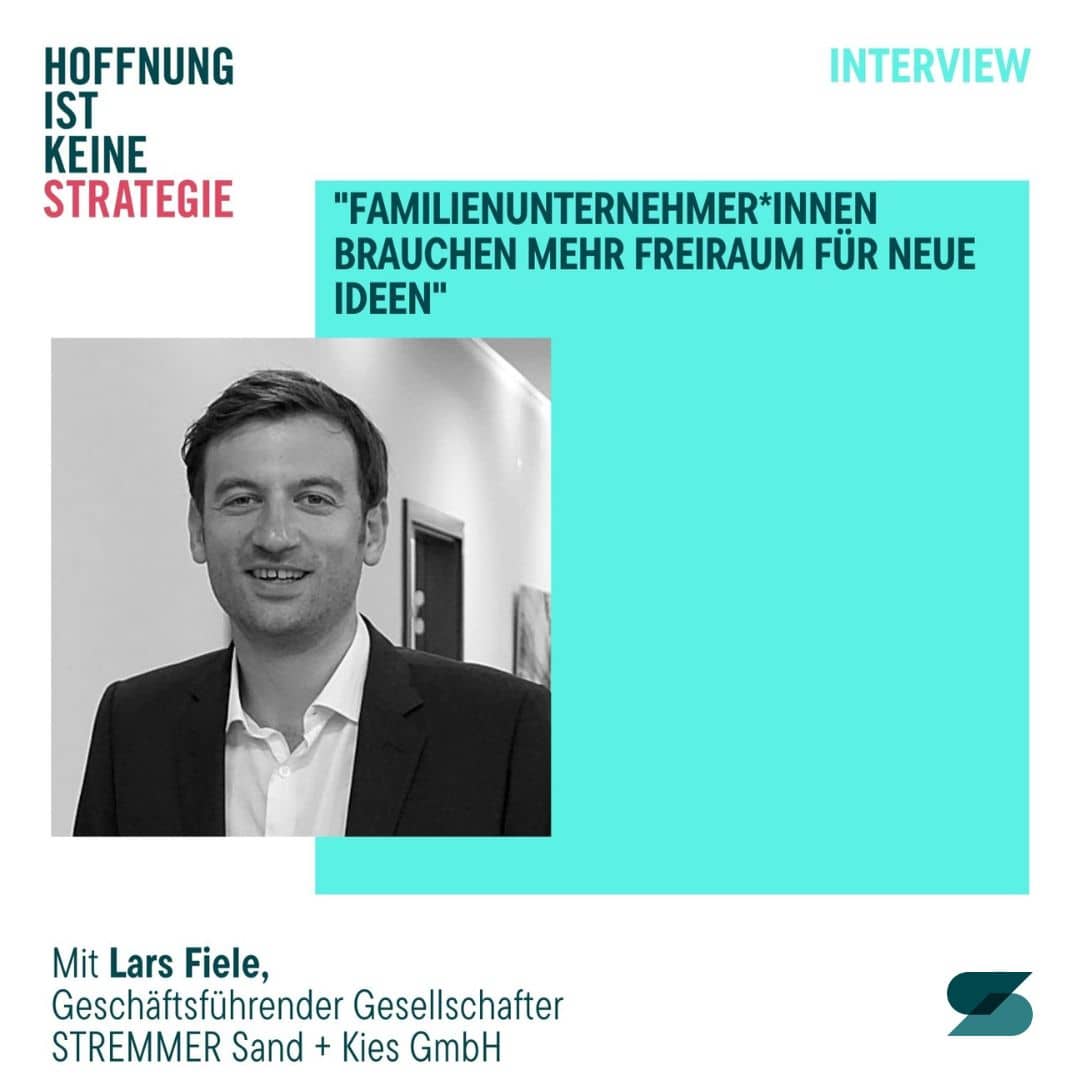
#19 "Family business owners need more room for new ideas"
This episode was recorded in German.
Family businesses face major challenges, especially when a generational handover is underway. Outgoing and incoming managing directors come together with different views and different life experiences. That leads to different views of the future, with each side assuming it knows what lies ahead. On top of that, every employee needs to be brought along and convinced of the new direction. What's needed here is the right mix of tradition and innovation.
In a world full of change and innovation, it's no longer enough to rest on a family business's past success and stick to the old ways. Anyone who wants a secure future for their company needs to keep developing, diversify and above all stay open and make room for new ideas. But that room is often painfully absent in day-to-day operations.
In this strategy interview, Christian Underwood talks with Lars Fiele, managing partner at STREMMER Sand + Kies GmbH, about how he has driven the company's digital readiness since joining the family business, both organizationally and strategically, in the core business as well as in new, innovative business models and business areas. How that can work, why apps and technology play an important role in a traditional industry, and how you can carve out room for yourself and explore new topics despite running a business: find out in the new episode of "Hope Is Not a Strategy."
SHOW NOTES:
Detailed episode description:
About the company
STREMMER Sand + Kies GmbH is a family business founded in 1938 in Bottrop Kirchhellen and now run by Lars Fiele in the third generation. With its STRESAN brand, STREMMER Sand + Kies GmbH is the leading supplier of riding arena sand in continental Europe.
Lars Fiele: about him
Lars Fiele earned his MBA at WHU. Before that, he completed a degree in business administration at ISM in Dortmund. He worked in change management at E.ON Ruhrgas AG and, as Director Consulting at netStart, led the ventures and consulting activities of the company founded by Professor Kollmann, one of the co-founders of Autoscout24 and one of Germany's leading digital minds.
Lars Fiele has been part of the management of the family business STREMMER Sand + Kies since 2013 and its managing partner since 2017. He is also co-founder of ABOUT my Horse, a social commerce platform for riding fashion, a shareholder in Bernds Reitbodensysteme and a partner at 1stMOVER Management in Düsseldorf, an innovation consultancy for startups, scaling and technology platforms. Alongside his political engagement, he is a successful startup investor and active with STARTUP TEENS, among others.
Tradition meets innovation
STREMMER Sand + Kies was founded in 1938 by Lars Fiele's grandfather Franz Stremmer as a small company with a single truck. The company has grown steadily since then, its strategic focus has been redefined, and it has exited some earlier business areas such as civil engineering and earthmoving.
In the 1990s, demand for high-quality riding arena sand rose sharply, driven in part by growing knowledge about equine health. Hermann Duckek, at the time the riding arena builder for the German Olympic Committee, was impressed by STREMMER's sand. Lars Fiele says that almost every successful company has had a moment of luck, and that was STREMMER's bit of luck: it allowed the company to grow strongly in the riding arena sand niche. Today STREMMER supplies riding arena sand especially across Western Europe, and the niche accounts for an important share of the entire business.
What sets STREMMER apart is its combination of tradition and innovation. The industry is a fairly traditional one and left innovation aside for a long time, simply because there was no need to act.
Now, though, the company faces the challenge that a lot is changing, especially at the political and social level. Demand is rising while availability is increasingly limited. So the company has to ask itself what the next 80 years should look like. Lars Fiele started thinking early on about what alternatives a family business like his could pursue while staying close to the core business. That's why innovation plays such an important role here: it opens up perspectives for the future.
How Lars Fiele came into the family business
Joining the family business wasn't Lars Fiele's plan from the start. He spent a lot of time abroad and worked at various companies, including large corporations and consulting firms, where he picked up a great deal of knowledge, met great people and experienced a lot. But with that experience, he also came to appreciate the opportunity to join a family business that was running well. Here too, Lars Fiele makes clear that this opportunity involves a degree of luck that not everyone has.
The decision came after many conversations within his family. A decision like that always involves other people, and in a family business the family in particular. It has to fit your concept of life, and it comes with a lot of responsibility.
The handover between two generations and the human factor
Succession is always a challenging topic. Two generations come together with different views and different experiences, which also produce different ideas about the future. Each side believes it knows what might happen next, and that differs from generation to generation.
When Lars Fiele took over the company from his father and his uncle, he faced two big challenges.
First, understanding where the company currently stood and what possible futures were open to it. Second, figuring out how to bring the employees along on that journey.
The human factor in particular plays an important role in business succession, and not only in terms of strategic direction. While getting up to speed yourself, you also have to find the time to get existing employees excited about your direction and, at the same time, announce new paths that can only be taken together with them and their know-how. That starts with many conversations to build trust, because the employees don't yet know the new managing director and at that point can't judge whether or which capabilities he brings to the table.
Modern internal communication
To make communication better and more engaging, and to make it work for every part of the business, STREMMER introduced a range of tools.
The company is set up in a decentralized way, and most operational employees don't work on site. They need to be reached, sometimes on very short notice. An email exchange isn't a workable solution here. So the company introduced several apps to enable fast, uncomplicated communication. Overall, digitalization plays a very large role for STREMMER.
Process optimization and innovation
At STREMMER, every process, analog or digital, was first examined closely for optimization potential, because a bad analog process is usually a bad digital process too. Then the team checked whether necessary analog processes would be easier to run digitally. Early on, Lars Fiele made the mistake of wanting to digitize processes that don't necessarily need to be digitized. Over time, he learned which analog processes work better digitally and which don't. The important thing is to keep optimizing processes continuously.
This isn't only about digitalization, such as rolling out apps, improving communication or simplifying forms. The company is also subject to strict occupational safety requirements, which have to be communicated and monitored.
That's why the company introduced things like digital training sessions that can be completed online and in multiple languages. Various programs make sure that all employees understand what happens in the company and what their personal role in it is.
STREMMER has made it a principle to keep reviewing its processes well beyond the transformation phase. Some processes are very easy to optimize, but until now nobody had taken care of them. Going forward, no process should settle in and quietly carry optimization potential that nobody spots.
Alongside process optimization and development, innovation plays a major role in the company. The industry is moving forward, technologically as well, but it faces big challenges overall. Energy in particular is a major issue, and it's one Lars Fiele can't influence directly. Even with large solar installations, the extraction sites, which aren't generally connected to the power grid, can't run on solar alone. Power always has to be brought in from the "normal" sources, which drives energy costs up. Changing that is hard at first, even if you say you want to rely on renewables.
Sustainability
Because the work happens directly with, in and on nature, sustainability matters a lot at STREMMER. With its truck fleet, the company works to minimize CO2 emissions. They're measured, recorded digitally and evaluated monthly as well as day by day, then published internally. There's no external interest in this data yet, but the assumption is that this will change. STREMMER is working hard to reduce CO2 emissions and improve the company's ecological footprint. Employees are being made aware of this as well.
At some point there will be no sand left in the extraction area. That's why the company's outlook rests above all on diversification and on preparing very early. But you can only broaden your base if you know what's possible. And you only know what's possible if you get out there and look at things. That means drawing on many sources, such as trade fairs and conversations with potential future clients, where Lars Fiele picks up new ideas for innovation and for the company's future. He also encourages his team to spend as much time as possible talking to other people and collecting ideas.
Finding new fields
To find new fields, three pillars matter most to Lars Fiele.
Bring in ideas from outside. Above all, that means networking and open communication, a willingness to take new paths and to bring young, creative people onto the team, support them and invest time in them. STARTUP TEENS is a good example. That's how the current GurtGrip project came to STREMMER: a young man was looking for someone who knew the equestrian world and could support the market launch of his idea for a special saddle pad.
Encourage people to speak up with ideas. It's important to signal clearly to the people around you every day, your employees, for example, that they should voice their ideas, to show you're willing to support those ideas, to create room for them and to take away the fear of failure. When ideas were tried in the past and it turned out after a few weeks that they wouldn't work, it mattered a lot to Lars Fiele to let the person know that while this particular idea didn't pan out, he was still looking forward to more ideas and impulses from them.
Create entrepreneurial freedom. Finally, Lars Fiele himself, together with his family, plays an important role. As the youngest in the family team, he's the one who carries the responsibility for leading the company into the future. He puts a lot of thought into that and tries to keep his head clear for new ideas. Since that's difficult amid day-to-day operations and the current crises in the world, he advises everyone to find their own way of doing it.
Lars Fiele creates that space through sports, going for walks or getting up early and taking an hour for himself, without input from anyone else, to think about new, interesting ideas. His best ideas come to him in quiet moments.
Entrepreneurial freedom creates new ideas
Creating room to think is especially important when developing innovations. One way to do that is to draw on the resources available inside the company. That includes accounting, infrastructure in terms of office space and IT, and access to lawyers, notaries and tax advisors. This lets founders focus entirely on their core business, and that's exactly what they should do.
For Lars Fiele, though, the decisive factor is people and their attitude. He's developed a 70/30 rule for himself. The 70% is a person's expertise, the basic prerequisite. But how that person shows up in terms of friendliness, openness to the world and attitude, not just toward work but in dealing with other people, is just as important to him as technical expertise.
You need people you can rely on, who work independently and who want to act entrepreneurially themselves. It also makes sense to talk through problems with these people regularly.
Finding top performers
There are different ways to win good people for the company. For operational and blue-collar roles, social media channels are the classic model. Beyond that, the company works to be known and to protect its good reputation, which is generally an important criterion for the company brand.
When looking for suitable managing directors, the company relies first and foremost on its own network, which has always worked well. Bernds Reitbodensysteme is one example: Lars Fiele had known Björn Bernds, the managing director and co-shareholder, for years beforehand.
So it's crucial to work on your network continuously, build it in the right direction and really get to know people over time.
1stMOVER Management and building hubs
Besides his work as an entrepreneur, Lars Fiele also advises the innovation hub 1stMOVER Management. The company has been around for 15 years. The founding partners have been active in the digital scene for a very long time and are highly successful there. 1stMOVER Management is a kind of innovation consultancy that, beyond digital, specializes in building new business models.
They used the build-out of the digital hub in Düsseldorf to develop further hub models.
Most recently, they built the hydrogen startup hub "H2UB" in Essen together with Open Grid Europe. There, hydrogen-related startups can develop alongside a range of participating partners. Among other things, the goal is to grow hydrogen across Europe and at the industrial hub in the Ruhr region.
By now, day-to-day operations have fully transferred to the hub, and 1stMOVER stays on only as a sparring partner for a while.
There are already more hub ideas for all kinds of innovations currently on the market. The aim is to concentrate them and create the opportunity for startups to use the existing infrastructure of large companies, while large companies get the chance to learn about the ideas and developments coming out of startups. A win-win situation.
Lars Fiele's tips on creating entrepreneurial room for new ideas
The most important thing is good employees and partners you can rely on. It matters to be able to stay away and still trust that the business is running. That also means investing in people and being an attractive employer.
Beyond that, you have to create space for your family and for yourself, to think, to tackle new things and to keep developing yourself and the company.
Contact:
Need help planning your strategy process? Send an email to christian@underwood.de.
Thanks for your interest, and see you in the next episode…
…Because HOPE IS NOT A STRATEGY.