

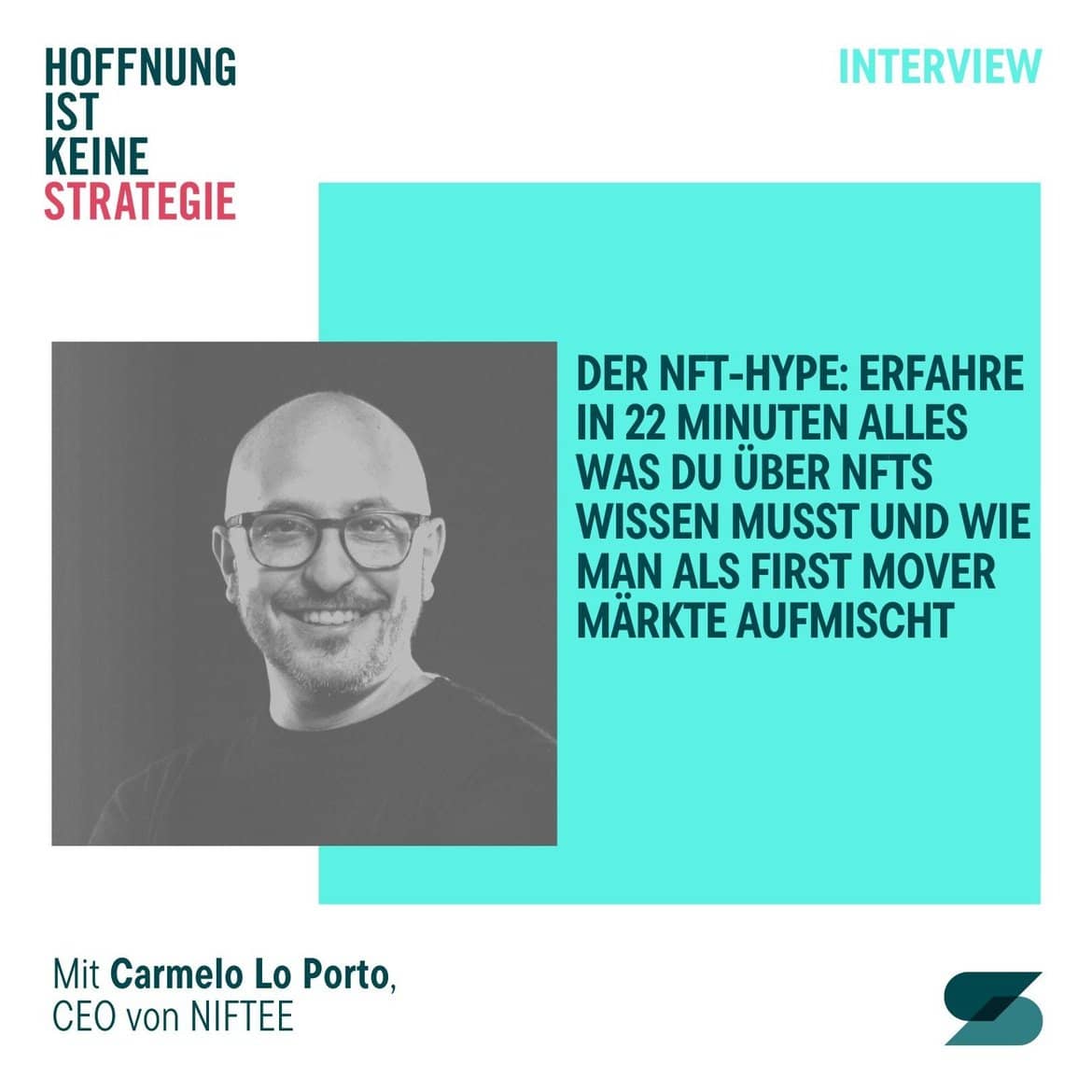
#11 The NFT hype: everything you need to know about NFTs in 22 minutes, and how first movers shake up markets
This episode was recorded in German.
Christian Underwood in conversation with Carmelo Lo Porto, CEO of NIFTEE.
In this episode, we talk with Carmelo Lo Porto about NFT art auctions, the strategy it takes to launch a business that doesn't exist yet, why German rappers of all people are true first movers, and which top auction is waiting for the world on November 21, 2021.
Steven Spielberg's film Ready Player One already offers a first glimpse of what tomorrow's world could look like. In a world that plays out almost entirely in digital form, digital ownership becomes more and more important. In the future, for example, it's conceivable that you'll cruise through the metaverse in your digital Porsche instead of buying the car physically. What that takes is the courage to take risks, to develop business models that have never existed before, and to throw entire industries into chaos. Carmelo has that courage, loves upheaval, and always asks himself how a company can put itself at the head of a movement. In September 2021, he turned his crazy idea into reality and founded NIFTEE, Europe's first digital auction house for NFTs, in other words digital works of art, centered on pop culture. In doing so, he proved one thing: ideas are only crazy until you pull them off.
How exactly Carmelo entered the market as a first mover, why excessive planning can kill innovation, and why you don't always need startup competitions, pitch decks and market analyses to find investors: find out in our new episode, "King of NFT."
Detailed episode description:
Christian Underwood in conversation with Carmelo Lo Porto, CEO of NIFTEE.
Carmelo Lo Porto's professional background: Carmelo Lo Porto is the CEO of NIFTEE, the first European auction house for digital NFT art. He started out in traditional business with training as an industrial clerk, before realizing his first small dream in 2005 and founding his own label, Antstreet Records, where he took his first entrepreneurial steps. Ten years ago, he moved to the music management side with Ever Ever Music, guiding young artists into the market. Among others, he worked with Nicole Cross, one of the first German musicians to gain serious recognition via YouTube. Today, too, he keeps looking for new paths, marketing artists like Jolita and Broys through networks such as TikTok.
NIFTEE got off the ground three months ago, after Carmelo took a closer look at NFTs for the first time in late 2020. The first auction took place at the end of September.
What an NFT is:
NFT may not be a familiar term to many people yet. So Carmelo starts by explaining to all listeners what NFT actually means. NFTs are digital works of art that are verified via a blockchain and thereby become one of a kind. So it's a kind of certificate of authenticity that confirms this NFT really is the original work. Compared to the analog art trade, imagine you get a genuine Leonardo da Vinci. On the back is your own name, because you're the current owner. Below that are the names of all previous owners, something only the original has.
The value of digital art:
One question many listeners are surely asking: why would anyone want an NFT in the first place? For Carmelo, though, why you want to own a work of art isn't a question of physical versus digital art. With art, it's always debatable why you want it. Why, for example, would you hang up a canvas painted by some other person? That's always a subjective feeling, tied to an individual's love of art and the emotions that go with it. Beyond that, of course, you assume that art carries a certain value and can also be used as an investment product.
With NIFTEE, Carmelo has set himself ambitious goals. He only wants to capture the most valuable moments and emotions in pop history there, which is why he started with Cro and Kool Savas. In September, four of Cro's masks and the lyrics to Kool Savas's "King of Rap" went under the hammer. For the occasion, Kool Savas burned his physical artwork and the original sheet of paper in order to create a digital work of art. For Carmelo, that process alone counts as a work of art.
How much money you can make with digital art:
Of course, an auction house lives off the artworks selling at a very respectable price. Cro's masks brought in €50,000, and Kool Savas's lyrics even went across the digital counter for €150,000. These examples already offer a small look into the future and show that NFTs are here to stay.
Pop culture artworks aren't only musical:
Auctioning off the most beautiful, biggest things in pop culture isn't limited to music. Cro and Kool Savas covered hip-hop, and the heavy metal scene has already been served with XXX Records. Comedians and motorsports are other areas Carmelo is working on. Here, too, emotions play a big role, and there are terrific works of art that aim to capture them.
What NIFTEE stands for:
In its marketing, NIFTEE has taken an approach that positions it very much as a filter. There are already plenty of NFT platforms, especially in the US, that play the volume game. NIFTEE has a strict door policy; it sees itself as Sotheby's, not eBay.
Are NFTs a new monetization opportunity for musicians and artists, especially after the tough times of the coronavirus crisis?
It's hard to view monetization alone as the new opportunity. That would be like saying, when the printing press was invented, that it was a new way to monetize thoughts. NFTs open up an entirely new world.
During the pandemic, Carmelo did in fact discover many new opportunities in the digital world. Like many others, he sat at home with his son, doing homeschooling and working remotely. It was also the time when his son was first allowed to play Fortnite and GTA online. That's when he recognized how the future of commerce and digital goods will likely develop in a world that keeps getting more connected. The metaverse, a universe that plays out on a purely digital level, will matter more and more. As an example, Carmelo points to Facebook, which recently renamed itself Meta and is currently building its own metaverse with the help of many developers in Europe as well.
With all the digital possibilities the future holds, companies now have to ask themselves how to put themselves at the head of the movement. Carmelo wants to walk that path himself and play an active role, instead of just watching and then complaining at the end that others did a poor job of it.
The first-mover approach:
With the invention of the internet and streaming at the latest, the music industry had to learn the hard way that you have to take new paths and that selling records, cassettes and CDs alone has no future. Many companies run on hope and figure things have always worked out so far. Carmelo sees it differently: things have never actually worked out when all you did was hope. Either you decide, or time decides for you. If, as an entrepreneur, you choose to wait and see, you may miss the connection that matters most and lose your ability to shape and influence anything. In the end, you'll have to work the way the industry has dictated.
That said, the music industry has repeatedly managed to reinvent itself and prove how fluid it is, not only in the shift to streaming, but also with new monetization paths such as different kinds of brand collaborations in hip-hop, Capital Bra's iced tea being one example.
Carmelo is a huge fan of exactly this kind of upheaval. He loves it when an industry is in chaos, the way NFTs still are right now. Once you can get in yourself and help determine how things go, that's when it starts to get really interesting.
The courage to take risks when entering business models that don't exist yet:
The approach taken by Carmelo and his business partner Andreas Braun (CTO) differs dramatically from anything you might find at a university or in a textbook. First, they looked at the American market and quickly realized that German artists trying to place their NFTs in the US were getting completely lost in the noise. That's where the idea of filtering came from. They sketched it out fast, and within a few weeks they had lined up investors through phone calls in their own network. Then they got straight to work on development. Startup competitions, market analyses, pitch deck presentations in investor meetings: all of it was struck from the to-do list. You don't have time for that anyway if you want to be first. There was no grand plan, nobody spent six months analyzing risks. They simply set sail and headed out into open water. The whole process was a marathon run at sprint speed, so a lot of things were decided along the way. That's how they actually managed to be the first movers, something Carmelo is proud of. At the same time, it shows that it's entirely possible to build a company without filling 100 pages of market analysis on a market that didn't even exist yet.
What else is in NIFTEE's pipeline?
Together with their partners at Glowing Gears, NIFTEE launched the first motorsport drop from Team Manthey. The object is the Porsche that won the 24-hour race at the Nürburgring, scanned as a 3D model at a quality never seen before. Never seen before means 13–16 terabytes (!) of data stored in the ice. The NFT is the key to it. Later on, you'll be able to drive this car around the metaverse. That shows how early we still are compared to what will be technically possible in the future. Which means an NFT like this will rise significantly in value once the metaverse is actually available. A digital car is the absolute must-have for anyone still buying real ones.
DON'T MISS IT: When does the auction go live? On November 21, 2021, there's a Porsche, digital, as an NFT on NIFTEE!
Challenges: how competition helps you keep getting better
Carmelo sees competition as always good and always useful, because it forces you to question yourself and constantly reinvent. If you want to be part of the avant-garde and push technology to the limits of what's feasible, then it's all the better when competitors enter the field. Doing the same thing for 20 years won't produce innovation.
The customer's view: are NFTs only bought by crazy digital nerds?
The answer is no. Many customers already recognize the value of NFTs today and are also betting on appreciation. There's a lot of movement in the art market right now, because the conditions for buying gold or property have shifted for the worse and some people have identified art as the safer investment. The same development is expected for NFTs.
Looking ahead: where is this going over the next 3 to 10 years?
Steven Spielberg's film Ready Player One already offers a good glimpse of how the world could develop. You live in a world that plays out almost entirely in digital form. And in a digital world, digital ownership matters too. Carmelo even believes digital ownership could become more important than purely physical ownership. You can hang a work of art in your living room, but an NFT you can share with the whole world.
Takeaway: what does Carmelo advise when it comes to crazy ideas?
Crazy ideas are only crazy until someone executes them. Six months ago, the idea of an auction house for NFTs was still crazy. Carmelo did it anyway, and now it isn't crazy anymore. If you have an idea you believe in, start putting it into practice. Excessive planning can kill innovation fast, because you tend to look for reasons why something can't work. Instead, think in terms of solutions and look for the reasons why it can work. What's needed, what has to happen, and what constellation has to be in place for the plan to succeed? And even though excessive planning holds innovation back, you absolutely need a very good strategy. NIFTEE's strategy leaned heavily on working in an agile way. Making mistakes and learning from them was also very important, and it strengthens you personally as well. The worst thing that can happen to you is making no mistakes at all. Then, when you finally make one, you never learned how to respond and you're out on the first try. Relying on experience in the decision-making process leads to no longer questioning yourself.
Napoleon won all of his first battles and lost all the ones after that, for exactly that reason, Carmelo thinks.