

WIK Group:
Mission Octopus
How WIK Group is shaping a strategic transformation toward sustainability with StrategyFrame®.
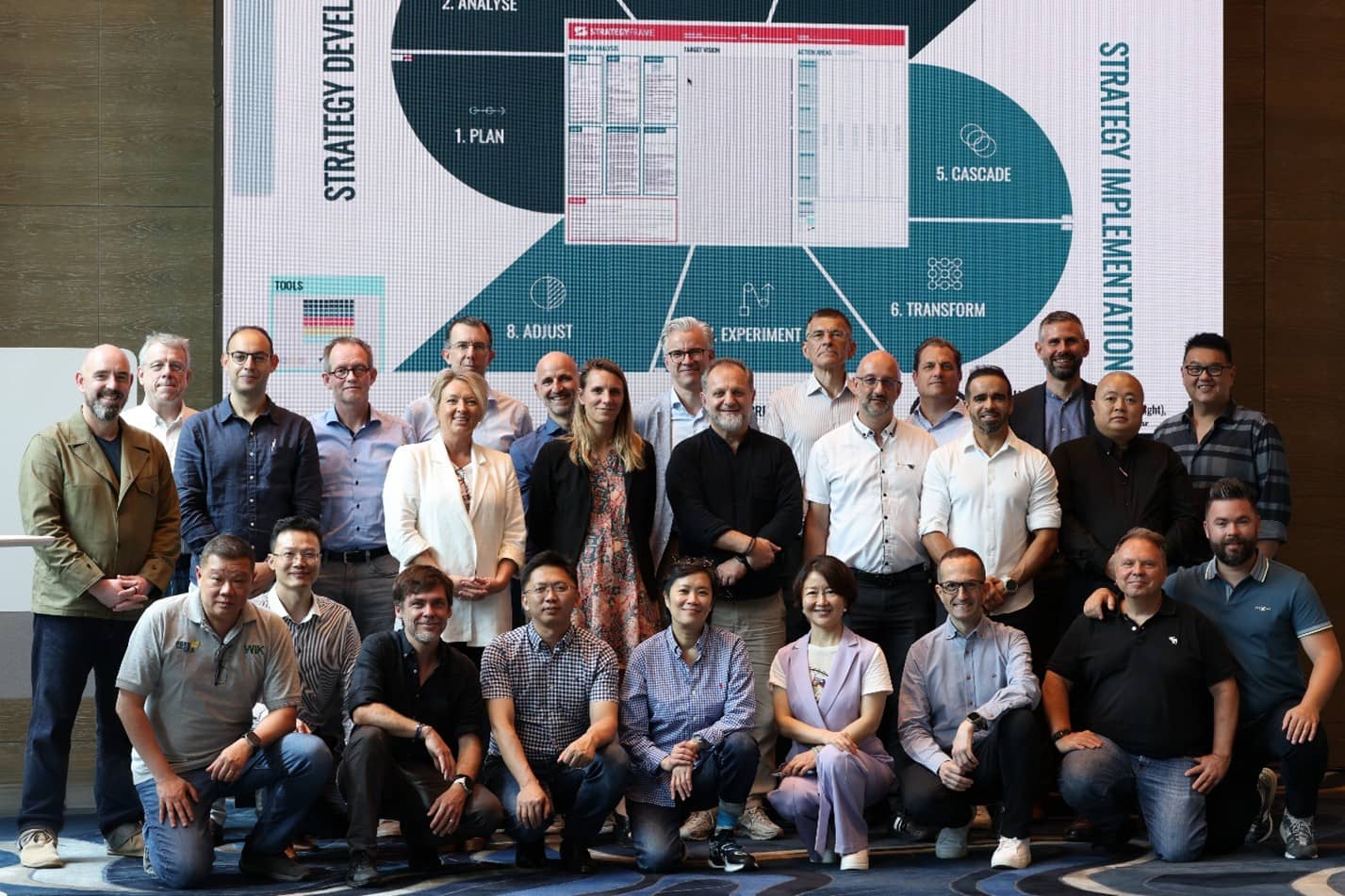
Step up to lead the family business? Run a large, internationally positioned mid-sized company that, of all things, develops and manufactures household and electrical appliances? For Christoph Dörn, CEO of WIK Group since 2016, it was far from clear for a long time that this would be his path. Not because the company hadn't been successful. Out of a small operation founded by his grandfather in Essen during Germany's postwar boom, his father had built a globally thriving company with thousands of employees over the decades. Valued by the major brands it manufactures products for as an OEM, with production sites in China, Indonesia and North Macedonia. Christoph didn't take the decision about the top job at WIK Group lightly for a different reason: coffee machines, kettles and tea makers, and even more so devices like hair straighteners, which are part of the product portfolio, have traditionally been seen as anything but sustainable. Plastic and electronic components burden the environment. Christoph, a committed advocate of sustainability, therefore paired his "yes" to the CEO role with a firm resolution: to realign the company. In a way that would allow it to make a real contribution to climate protection going forward.
"Stuck in the middle"
"There were already good initiatives before we started the strategy process," says Daniel Venuso, brought on board by Christoph in 2024 as Head of Strategy & Business Development to drive the transformation further. "But they existed side by side. What was still missing was an overarching target picture and clear priorities." All the more necessary because management was very aware that WIK Group risked walking into a strategic trap over the long term. The many years of success had created a mindset in the company that focused almost exclusively on day-to-day operations. Geared above all toward efficiency, the organization had barely any room to work on innovation. In markets that keep getting more complicated and are purely price-driven in some segments, that's a potentially dangerous mix. Daniel: "Either you have a clear differentiator compared to the competition. Or you move toward cost leadership." Lacking priorities, WIK Group's own analysis put it almost exactly between those two poles, and therefore "stuck in the middle."
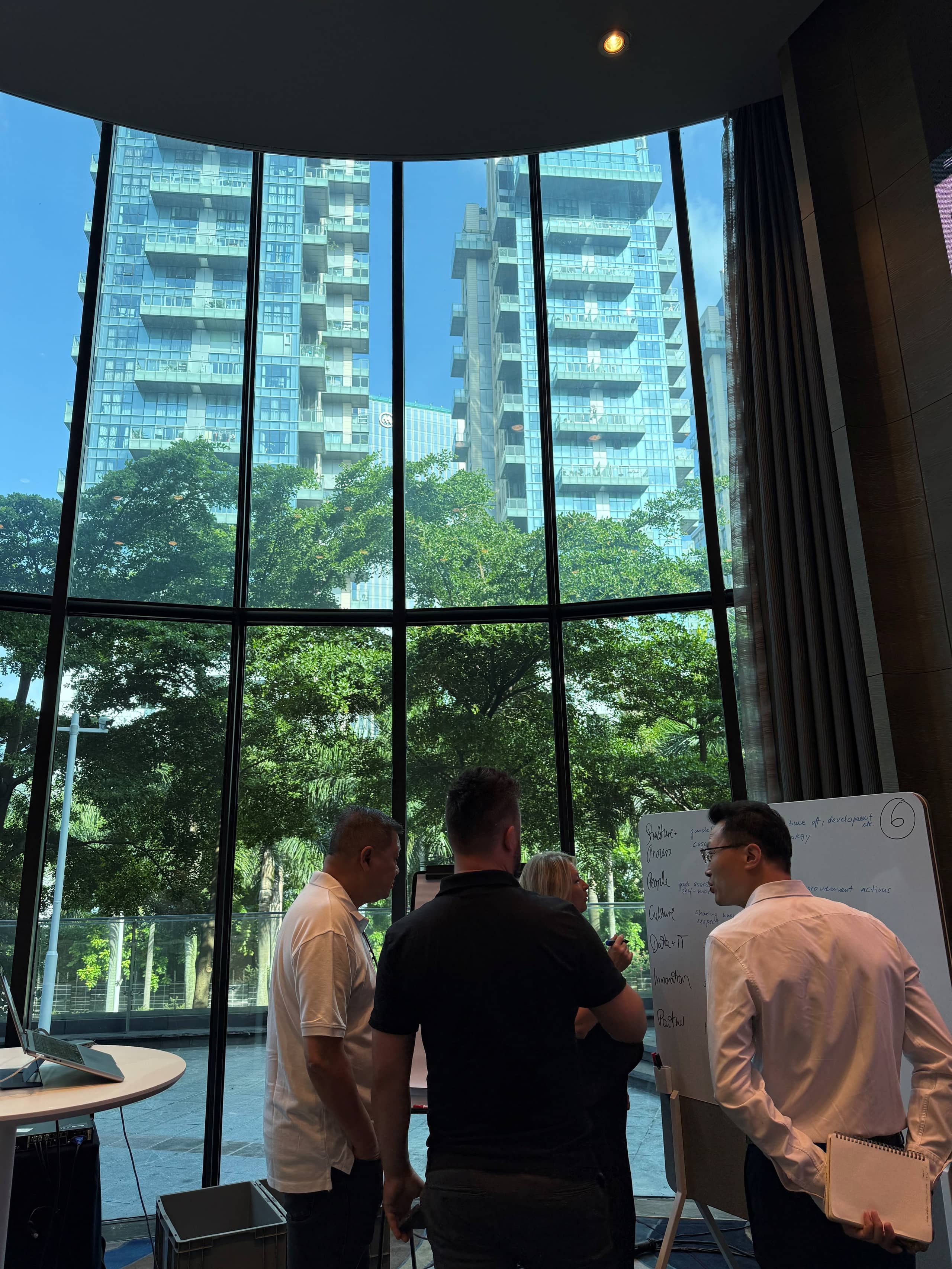
"The second workshop really got the ideas flowing"
Situation analysis, target vision, action areas: by the first workshop in May 2025 in Interlaken, most of the content of the StrategyFrame® was already in place. Management agreed that the sustainability criterion would have to be built into every process in the company going forward, a fundamental shift in paradigm toward bold differentiation. Which business areas do we give up if we really want to see this through? Which ones do we want to focus on? And is the company prepared to accept temporary financial setbacks for it? These were uncomfortable questions to put on the table. "That's why it was so helpful that the StrategyFrame® provides the processes and methods," Daniel says. "It left me far more mental capacity for the analysis and for facilitating internally." At the second workshop in July 2025, this time in Shenzhen, China, the group expanded to include all heads of functions and the plant managers. Their feedback on the target picture developed earlier and the first proposal for corresponding OKRs: extremely positive. In an intense dialogue, they contributed ideas for measures that support the goals, discussed production methods, the CO2 footprint and global collaboration. "The ideas really flowed. Even though strategy work was new territory for many of them. When we evaluated the ideas for measures afterwards, we identified some real gems," Daniel says.
Every tentacle a semi-independent part of the whole
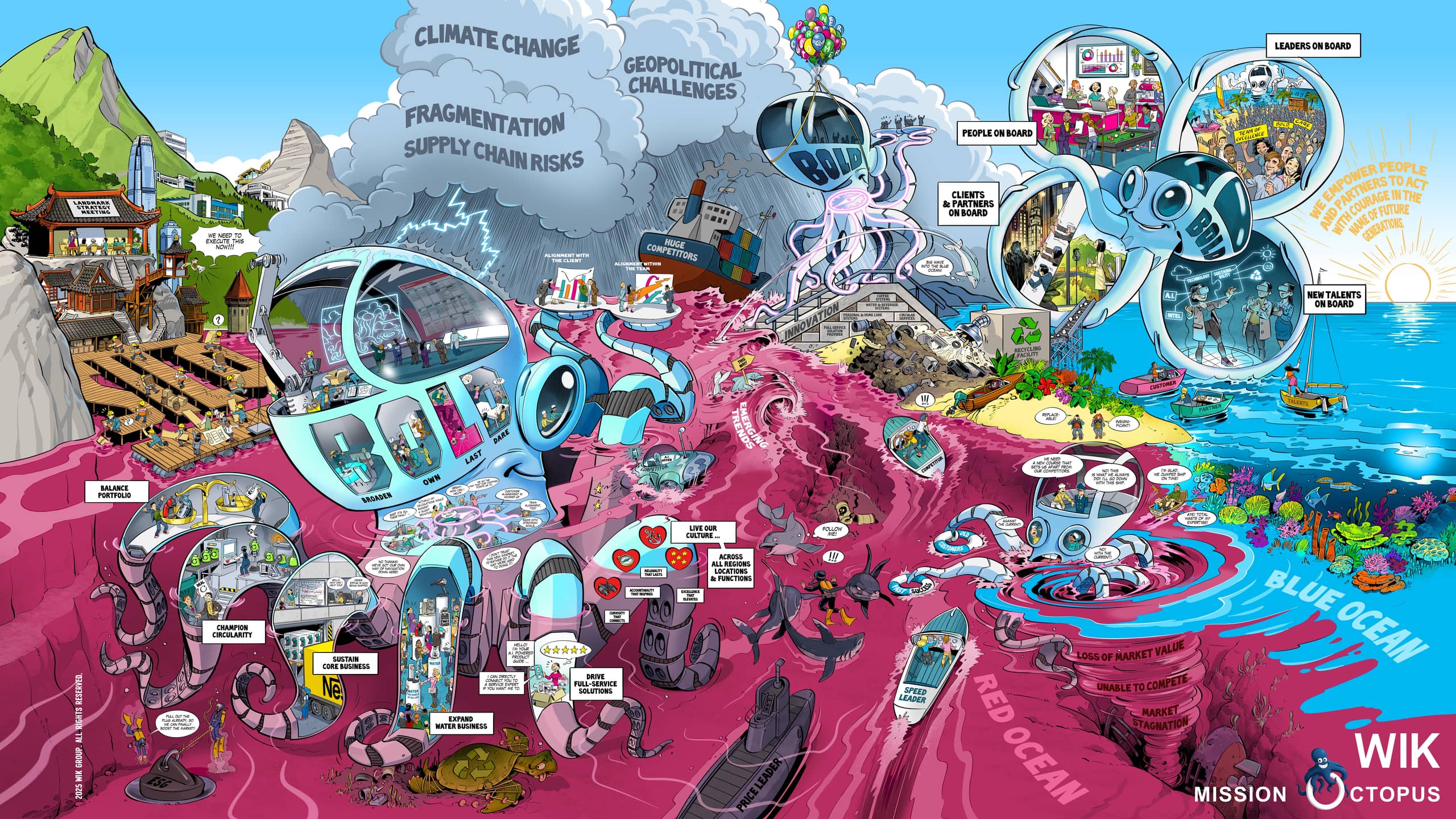
The next task: translate the finished strategy into a big picture that creates understanding and momentum across the entire company. To bring more employees into the process, strategy and organizational development launched a Catalyst Circle, a group of employees from various functions and levels of the hierarchy that filled the picture with life, scene by scene. "We approached it very openly, anyone could apply with a few words about their personal motivation. That paid off: the 45 people involved here were able to test new ideas in their own teams again and again, for example, and gather their feedback." In November 2025 the job was done, the strategy visualized in full glory. WIK Group named it Mission Octopus to capture the decisive qualities for the transformation in a memorable way. Daniel sees it as far more than just a strategic roadmap: "Mission Octopus expresses why we exist, how we want to work with each other and what we focus on." Octopuses are highly adaptive, intelligent creatures with not just a central brain, but mini brains in their tentacles and three hearts. Each tentacle can sense, make decisions and act as a semi-independent part of the whole. "That's exactly how we want to be as WIK Group: a clear purpose at the core, autonomy where it's needed, alignment where it counts."
First in focus: water and beverage systems
Mission Octopus has been rolling out since spring 2026, after an interim phase prepared the ground (see box). In clearly structured workshops, starting with the executive board and moving through every level of the hierarchy, the entire WIK Group team takes on the "Big Picture Challenge" until everyone is activated and contributing. It quickly became clear that cultural change, away from silo thinking and rigid structures, is a big part of this. "But we can see that people appreciate us breaking the old patterns, and they genuinely want to take part," Daniel says. Especially as it increasingly sinks in how seriously company leadership takes Mission Octopus. WIK Group keeps integrating sustainability further into its processes, is working on a unified IT structure and is questioning its existing organizational model. Instead of organizing mainly by function as it does today, the company wants to align more strongly around product categories in the future and introduce a new service category. The water and beverage systems business is a particular focus and is set to become the second-largest product category. The company plans to present its first proprietary technology platform for it to the industry next year. In parallel, it continues to build connections with new partners from the cradle-to-cradle world and plans to set up an innovation unit with plenty of freedom to shape its own work. A standalone unit dedicated to so-called circular services is also taking shape, so the company can offer targeted solutions beyond the classic life cycle in the future.
Leading by example and enabling others
"We empower people and partners to act with courage in the name of future generations" is how WIK Group sums up the company's purpose. Leading by example and pushing customers to design more sustainable products: that's the ambition. Internally, Christoph and Daniel are convinced, this takes a clear focus on the defined goals and the will to stay with it consistently. Daniel: "Mission Octopus isn't a quick vaccination with one short jab. We want to change our immune system for the long term." The most important thing, he says, is that real empowerment and enablement happen. "Above all, we want to enable the teams in the company and encourage them to take initiative within our strategy. Just like the octopus: the tentacles have freedom, and we still move in the same direction together."
Corporate Culture Compass Tour across all sites
With the WIK Group's repositioning, culture in particular has moved to center stage. "We want every employee to know from day one what we want to stand for and what defines how we work together," says Daniel Venuso. That's why Strategy and Organizational Development placed a dedicated program module ahead of the strategy activation, running from November 2025 to February 2026. On the "Corporate Culture Compass Tour," they discussed with the teams what purpose, vision, mission and the defined company values mean for each individual at the WIK Group. "It doesn't help if we reflect on this on our own here in Lucerne," Daniel says. "The team on Batam in Indonesia, for example, has to be able to connect with it too. That's why we deliberately made the workshop content very concrete and broke it down to the local situation."
The WIK Group: From OEM to circularity company
Founded in Essen in 1951 by Wilhelm Kruk, the WIK Group is today a prime example of an internationally successful family business in the appliance and household goods industry. The hidden champion has long worked as an OEM for major brands. Its portfolio includes coffee machines, water and kitchen appliances and personal care products, as well as components and material solutions. Development and production are based in Shenzhen, China, on Batam in Indonesia and in Prilep, North Macedonia. The administrative and service units work out of Essen, Hong Kong and Lucerne. The Swiss site replaced Hong Kong as headquarters in mid-2026. Since taking over as CEO in 2016, Christoph Dörn has been realigning the WIK Group strategically: away from the classic OEM manufacturer and toward an innovation- and sustainability-driven technology partner. The focus is on the circular economy, circular materials and cradle-to-cradle principles. This shift is visible in international C2C scorecards for the production sites and in initiatives such as "Free The Sea," which make recycled plastics from coastal waste and electronic scrap usable.