

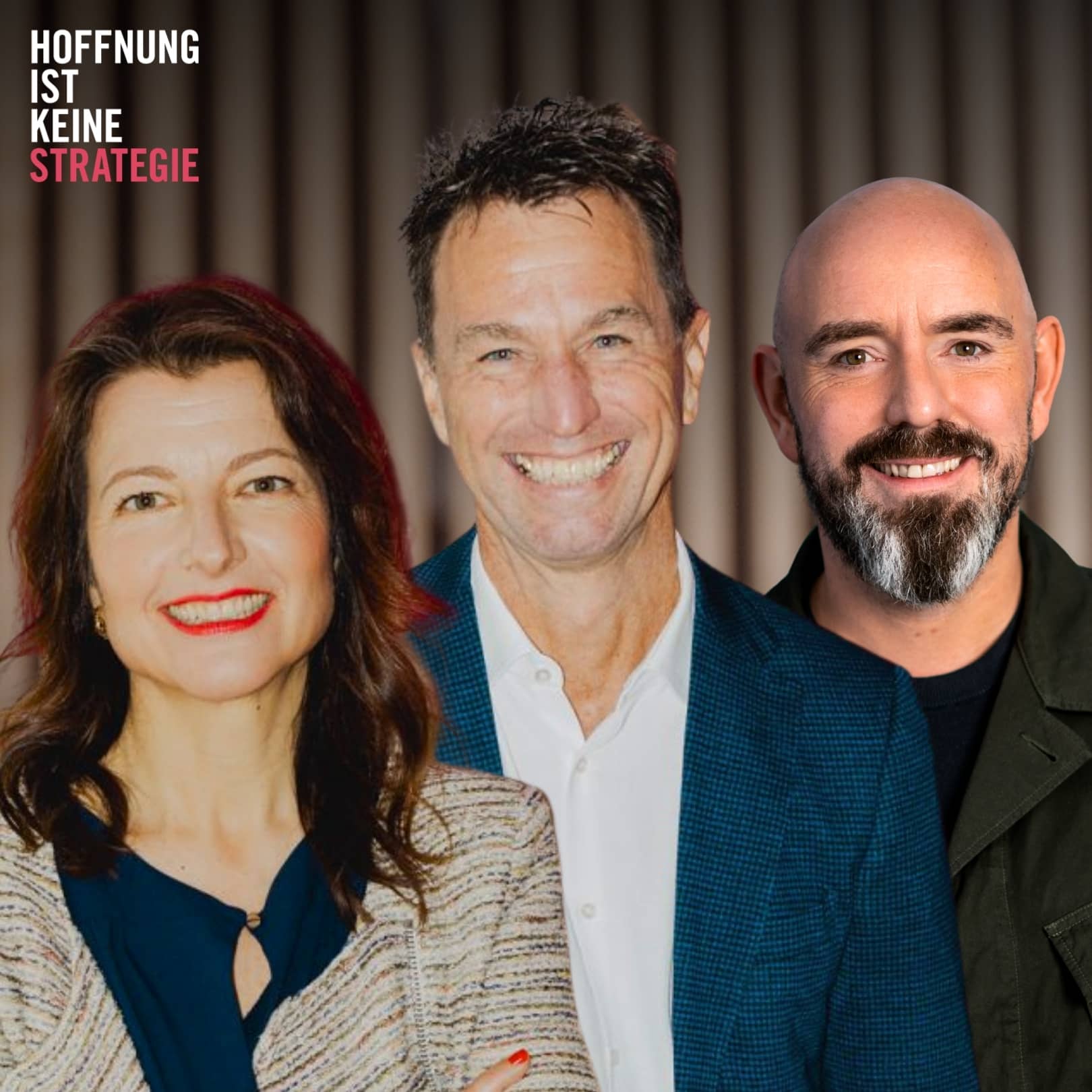
When everyone uses the same AI: how does your brand stay unique?
This episode was recorded in German.
Proven recipes for anyone who wants to turn their brand into a driver of growth and future success
A brand today is far more than a logo and a color palette: it's identity, orientation, and a lever for growth. Stefanie Kuhnhen, one of the best-known brand strategists for clients such as Edeka, Burger King, and Ikea, and most recently Chief Strategy Officer at Serviceplan, and Stephan Grabmeier, future designer and transformation expert with management roles at Deutsche Telekom, Haufe, Kienbaum, and Zukunftsinstitut and author of the book "Impact Business Design," have joined forces and founded everbrand. In our podcast, they show how the future, strategy, brand, and organizational development interact, and why that interplay leads to better decisions.
The brand as an anchor of trust, inside and out
AI, climate, geopolitics: so many fundamentals are shifting right now that the longing for something to hold on to keeps growing. "We see a huge longing for everything that creates trust, orientation, and identity," Stefanie Kuhnhen explains. Especially in times of AI and ever more fake content, people look for certainty, and a brand can become an anchor of trust. The same holds true internally: after the crises of recent years, many employees are exhausted. That's why, for everbrand, a brand isn't just a logo but "the identity, the self-image of the company," and it can reignite motivation and energy for the next big step.
Vision of the future, brand, and strategy: think and act systemically
Every transformation starts with a picture of who a company wants to be. "The future and images of the future create orientation toward where things should go," says Stephan Grabmeier. From that follows the future role: what role will I play as a company ten years from now? Purpose describes the why, the brand translates it into a clear image and a personality in the market. That's why the topic belongs at the board table. "Thinking systemically alone isn't enough. We also have to act systemically."
Brand drives value and growth
For the CFO or the commercial managing director, one question matters most: does the investment pay off? Stefanie Kuhnhen's answer: "We're not making this up. It's scientifically proven that a brand has a direct influence on purchase intent." A strong brand can command higher prices and win market share. At everbrand, a Brand Elevation Model does the job, translating brand into customer economics. In unpredictable markets, a brand also demonstrably helps you bounce back faster after a shock. The example: which store do people go back to first after the COVID shutdown?
Behavior changes through conditions
How do you get people moving? "Behavior only changes through conditions, meaning by changing the conditions," says Stephan Grabmeier. A strategy isn't decided on PowerPoint slides but in the daily, mostly small decisions. That calls for new rituals, processes, and ways of working. Using the gym as an example, he distinguishes three levels of change: the result (lose ten pounds), the process (train two to three times a week), and the identity ("I want to be a healthy person"). "We don't want to take people along, as people often put it. We want to create a space where everyone can also make a free decision."
One thought instead of 24 values
For thousands of small decisions to move in the same direction, you need something simple. "It really can only be one thought, because that's how our brain works, very simply," says Stefanie Kuhnhen. She points to examples like "We love food" or "Sheer driving pleasure." Anyone who knows what the company stands for can decide intuitively, even in unclear situations, whether to turn left or right. Decision-makers then don't have to regulate everything down to the last second. In this way, a brand helps people make intuitive decisions at the many small touchpoints in a company, internally and externally.
Use AI, but the last few percent stay human
In brand strategy too, AI creates more room to think big. But the direction remains a human decision. Because with AI everyone quickly arrives at the same 80 or 90 percent, the last ten to fifteen percent decide the outcome: attention to detail and a truly distinctive positioning. Transparency matters as well: in the strategy process, AI stays visible and traceable instead of running unnoticed in the background.
An invitation to act
For managing directors, brand and strategy leads, and anyone facing a transformation, this episode delivers concrete food for thought: from the question of what role the company wants to play ten years from now to the small rituals that anchor strategy in everyday work.
🚀 Listen to the episode now and find out why a brand is more than a logo or a campaign. It's the trusted anchor for creating value.
SHOW NOTES
Stefanie Kuhnhen https://www.linkedin.com/in/stefaniekuhnhen/
Stephan Grabmeier https://www.linkedin.com/in/stephangrabmeier/
Christian Underwood https://www.linkedin.com/in/christianunderwood/
Book "Impact Design" https://www.thalia.de/shop/home/artikeldetails/A1073091744
Book "Super Power Sustainable Marketing" https://marketing-superpower.com/
Strategic Decision Intelligence: https://strategicdecisionintelligence.ai
Magazine "Hope Is Not a Strategy" https://shop.strategyframe.ai/products/hoffnung-ist-keine-strategie-ii-1-strategic-decision-intelligence
All links https://linktr.ee/strategyframe