

From raw materials company to AI platform: The transformation of the Dorfner Group
This episode was recorded in German.
From raw materials company to AI-driven innovation engine: The transformation of the Dorfner Group
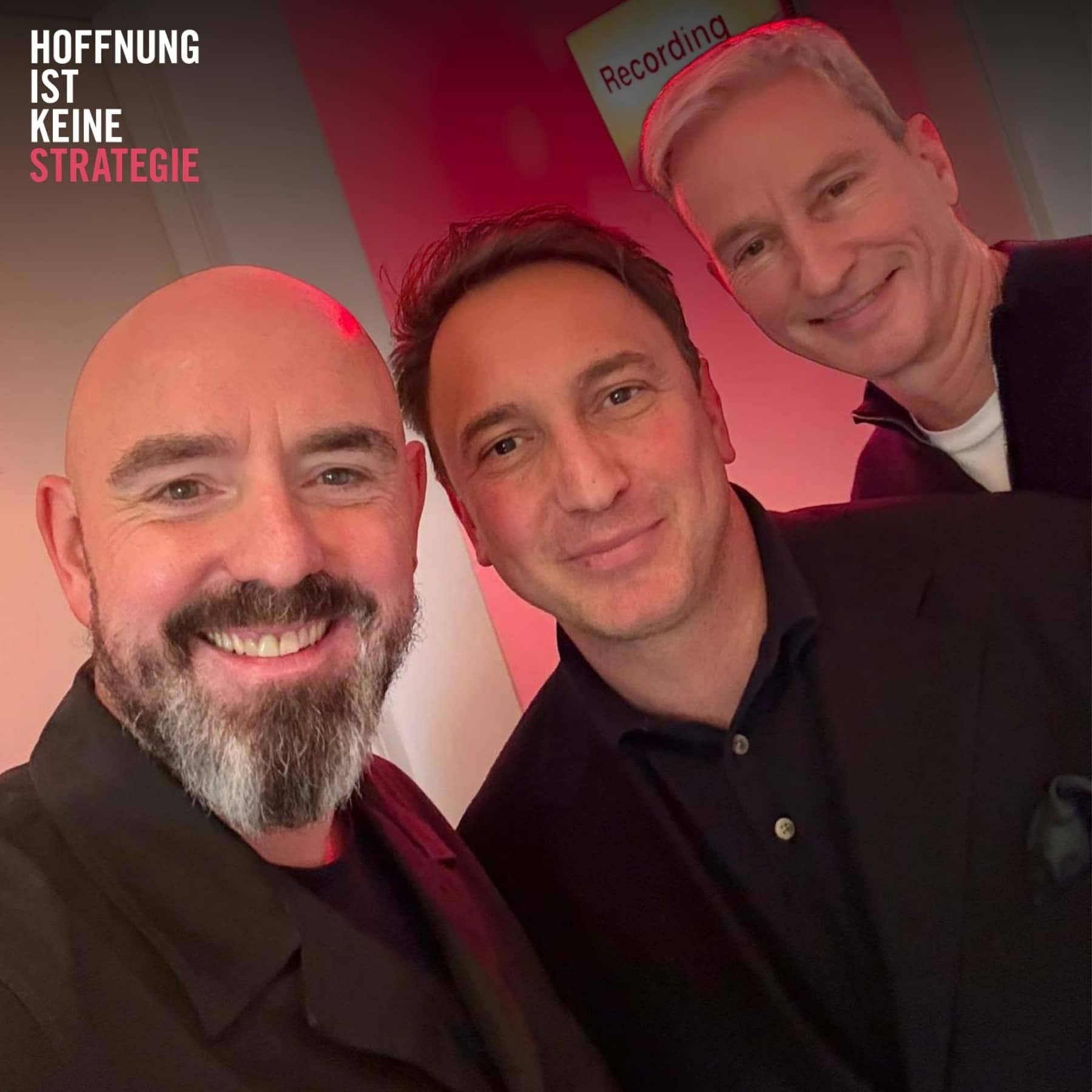
Artificial intelligence is usually associated with big tech corporations or digital platforms. But the story of the Gebrüder Dorfner Group is striking proof that a more than 100-year-old industrial company from the Upper Palatinate can also use AI to realign its business model. In the latest episode of the podcast "Hope Is Not a Strategy," Christian Underwood and Prof. Dr. Jürgen Weigand talk with CEO Mirko Mondan about how a traditional raw materials company becomes a data-driven innovation engine.
When data becomes a strategic treasure
Many companies own data, but few use it strategically. At Dorfner, that is exactly where the transformation started. For decades, the lab documented raw materials, minerals and chemical properties in great detail. In some cases, a single raw material was described using up to 50 parameters.
What was long nothing more than precise documentation turned into a real competitive advantage as computing power grew and new AI methods emerged. Today, those historical lab records form the basis for the company's own AI system, which can identify complex relationships between materials, properties and applications. A seemingly traditional data set became a strategic asset.
Strategy before technology
One point Mirko Mondan emphasizes in the conversation: the use of AI did not start with technology, it started with strategy. The first question was where the company should be heading long term. As a raw materials company, Dorfner faces a natural limit: raw materials are finite. A linear business model built solely on extracting more would have undermined its own foundation over time.
So the strategic challenge was this: how can the company grow without depleting its resources faster? The answer lay in its own core competence, raw material analytics and material formulation. That is exactly where the AI initiative began.
From experiment to platform
Using machine learning, the company began to rethink its lab processes. In the past, countless experiments were needed to find out how different combinations of raw materials would behave in specific applications.
Today, most of these experiments can be simulated digitally. The effect is enormous: test series that used to take several weeks or even months can now sometimes be completed within a single day. This new speed changes not only internal processes but also the value proposition for customers. Formulations, adjustments or new material combinations can be developed and tested far faster.
Sustainability through better decisions
The impact of the transformation goes far beyond efficiency. With a better understanding of material properties, Dorfner was able to cut its annual extraction volume by about 40% while extending the lifespan of its raw material deposits by roughly 20 years. That shows digitalization and sustainability are not opposites. Quite the contrary: combining data, AI and strategic clarity can help use resources more efficiently and unlock new economic potential at the same time.
Enabling people instead of replacing them
Another important aspect of the transformation is how the company deals with its employees.
Instead of treating AI primarily as an automation tool, the company chose a different approach: people should be enabled to work with the new technology. An internal program was launched in which employees from different areas built up AI skills over several months, from programming to data-driven work. The result is an interdisciplinary team that actively shapes the transformation. One particularly striking example: a master painter from the company developed into a talented programmer over the course of the program and today drives new AI ideas forward.
Mid-sized companies and their biggest opportunity
The story of the Dorfner Group illustrates an important principle for German mid-sized companies: the greatest competitive advantage often lies not in new technologies but in your own knowledge. Many mid-sized companies have decades of experience, deep industry understanding and unique data sets. When that knowledge is combined with modern technology, the result is solutions that outsiders can hardly copy. AI does not replace expertise, it amplifies it.
Transformation starts in the mind
In the end, the most important insight from this transformation may not be technological at all. The change began with a clear strategic question, the courage to experiment and the willingness to actively involve employees. Technology was a tool, not the starting point. Or as Mirko Mondan puts it in the conversation: strategy comes before AI. For many companies, that is exactly what separates hype from real transformation.
SHOW NOTES
Mirko Mondan https://www.linkedin.com/in/mirko-mondan-305245193/
Christian Underwood https://www.linkedin.com/in/christianunderwood/
Prof. Dr. Jürgen Weigand https://www.linkedin.com/in/j%C3%BCrgen-weigand/
StrategySummit 2026 https://www.strategyframe.ai/strategysummit2026
All links https://linktr.ee/strategyframe