

Leadership in times of crisis: why numbers alone won't help
This episode was recorded in German.
Entrepreneurship across generations: why listening, intuition and people decide the future.
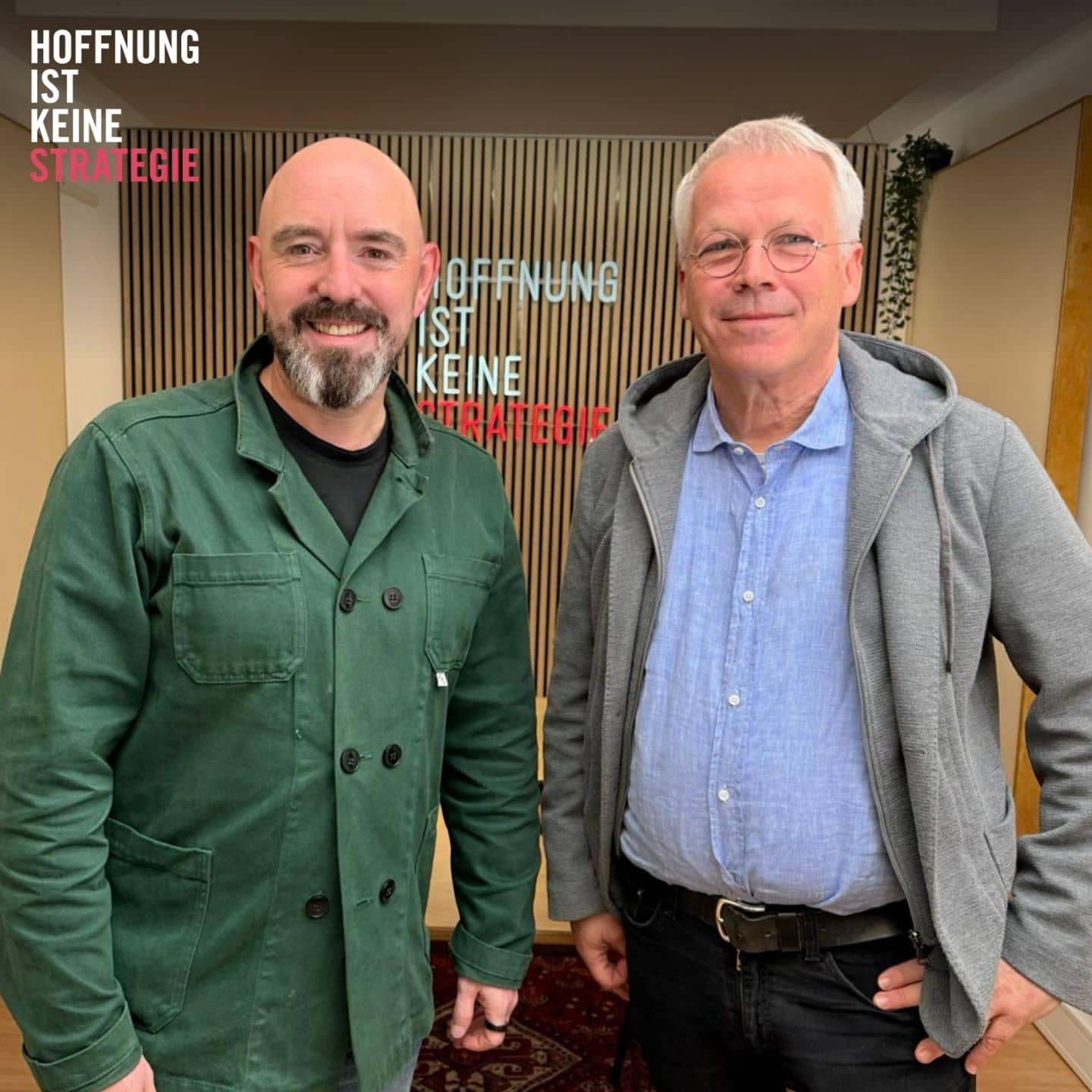
What does it take to lead a company not just through good times, but through crises, structural upheavals and technological disruption? In the latest episode of "Hope Is Not a Strategy," Christian Underwood talks with Gerd Röders, owner of G.A. Röders GmbH & Co. KG and president of WVMetalle, about exactly that question, from the perspective of a sixth-generation family business owner. The starting point of the conversation is a personal letter Gerd Röders wrote to the next generation. Not a textbook guide, but the distilled essence of more than 30 years of entrepreneurial responsibility and over 200 years of company history.
Leadership is more than arithmetic
"Running a company seems simple at first: income has to exceed expenses." But the path there is complex, and rarely purely rational. Gerd Röders describes vividly how he had to learn that leadership is not primarily about numbers, but about understanding people, situations and connections. Numbers are necessary, but they are not the core of leadership. If you only cut costs, you don't invest in the future. If you only optimize, you lose the ability to renew. Good leadership happens where economic reason and human perception come together.
Listening: the underrated leadership discipline
A central theme of the episode: listening is more active than talking. People in positions of responsibility in particular are permanently "on air." They're expected to decide, lead the way, deliver answers. But that's exactly what can obscure the view. Gerd Röders describes listening as a deliberate stance: pause, observe, don't judge immediately. Truly understand what moves employees, customers or partners, even when it gets uncomfortable. Because often the real information lies not in what is said, but in what is meant.
Intuition is not a gut feeling
In an age of data, KPIs and AI, intuition strikes many as suspiciously imprecise. For Gerd Röders, it's the opposite: intuition is condensed experience. It comes from three components: years of practice, deliberate reflection, and the ability to go quiet and look closely. If you react immediately, you often miss the better solution. If you observe, listen and think, you ultimately decide more clearly, even if it feels "intuitive."
Mid-sized companies in crisis, and why there are still opportunities
As president of WV Metalle, Gerd Röders speaks not only for his own company, but for an entire industry. Regulation, energy prices, bureaucracy, geopolitical uncertainty: the challenges are real. But the conclusion is not resignation. Every generation of the company had to reinvent itself: from pewter casting to fittings to highly complex aluminum die-cast and plastic solutions. The decisive location factor was never technology alone, but people. Qualification, creativity, curiosity and diversity are the real resource, then as now.
People before machines
One sentence from the letter sums it up: "Investing in people is often worth more than investing in machines." Machines are tools. Technologies, including AI, only create value when people understand, question and shape the processes. Anyone who believes problems can be solved automatically unlearns how to think. The future doesn't come at the push of a button, it comes from understanding.
Succession means passing on a mindset
For Gerd Röders, succession is not a technical handover but a cultural task. It's not about preserving structures, but about passing on mindset, curiosity and a sense of responsibility. Things that no longer work have to be allowed to die, without calling your own significance into question. Companies need a purpose beyond profit: for employees, for families, for regions and for society. Without impact, all the numbers are worthless.
Who this episode is especially relevant for
This episode is for entrepreneurs, successors and executives who sense that efficiency and optimization alone aren't enough. It shows why future viability grows out of listening, intuition, humanity and the courage to change.
SHOW NOTES
Gerd Röders https://www.linkedin.com/in/gerd-roeders-7a795b204/
Christian Underwood https://www.linkedin.com/in/christianunderwood/
StrategySummit 2026 https://www.strategyframe.ai/strategysummit2026
All links https://linktr.ee/strategyframe