

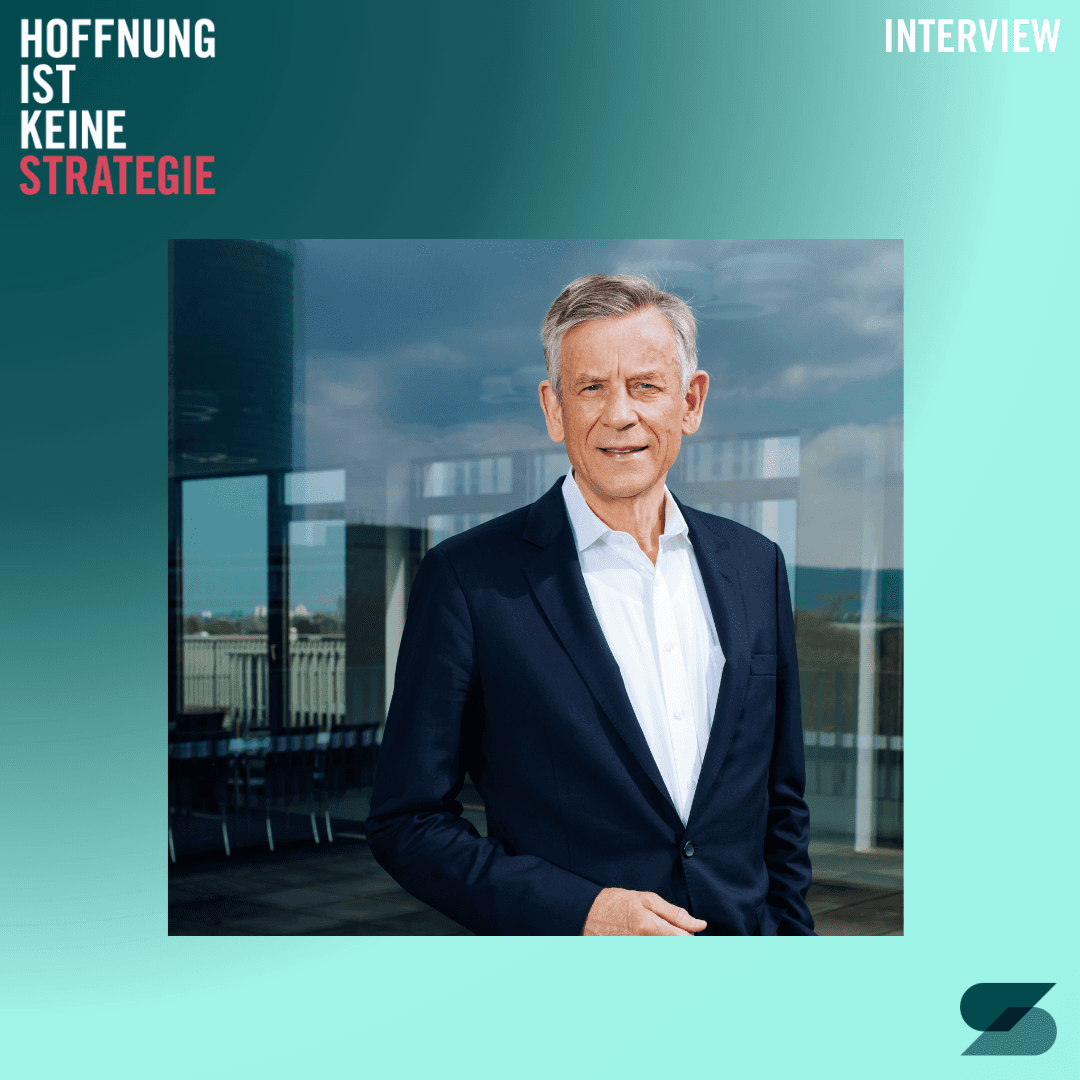
#62 Hermann Simon's strategic recommendations for volatile times
This episode was recorded in German.
The shift from a phase of stable prices into inflation happened just as fast as it did in the 1970s. Some of the driving forces were comparable, too. Right now, the pressure from the money supply will persist, and a wave of wage increases is coming on top of it. That's why Hermann Simon expects another parallel to the 1970s: a second inflationary surge. Realistically, Simon sees inflation settling somewhere between 4 and 6 percent.
Fighting inflation holistically
According to Hermann Simon, inflation affects every part of a company. Price increases are of course urgently needed when costs rise, but that alone isn't enough. It's also about getting the cost side under control to reduce the pressure on profits. On top of that, smart financial management should secure better payment terms and put money into assets that don't spoil.
Money is becoming a perishable good, and sales in particular faces the complex task of negotiating prices with customers several times a year. In times like these, it's not unusual for sales to go back to the customer eight times a year.
That's why Simon says you need an industry- and product-specific perspective to understand how much price resistance you'll meet with customers.
But price alone isn't the only instrument. Based on what Simon Kucher & Partners has observed over the past three years, roughly 50 percent of cost increases can be offset by price increases. Another 25 percent can come from efficiency gains and cost reductions. The remaining 25 percent comes out of profit.
Pricing customer value correctly
Pricing is especially hard with genuine innovations. Simon identifies three specific price anchors:
costs competition and customer value
Today, around 80 percent of all prices are built on a cost-plus basis, because quantifying customer value isn't easy, especially for new products with no competitive anchor. Only when we truly understand the value can we derive the price. Costs and prices are numbers, after all, so we need a number for customer value too.
But it's not just about a single price, it's about new pricing models. Simon quotes Socrates here: "The value of a product does not come from owning it, but from using it." In his view, there has been more innovation here in the past 20 to 30 years than in the 2,000 years before. Digitalization in particular made pricing models like freemium and pay-per-use possible in the first place.
Focus on profit
Profit margins at German Global Fortune 500 companies were low last year by international standards. In Simon's latest study, Germany ranks last among 15 countries with a net return of 4.1 percent (only countries with at least five Global Fortune 500 companies were included). The US leads the ranking with 8.3 percent, followed by Switzerland with 9.1 percent.
For Simon, that raises the question of the quality of German management. The many failed acquisitions by large German corporations in recent years seem to underscore the point.
From hidden to open champions
Overall, the hidden champions are doing far better than the German economy as a whole or than large corporations. Hidden champions aren't immune to the risks of our time either. But these technologically innovative, internationally well-positioned companies are in good shape, according to Simon.
The key principles of the hidden champions haven't changed either:
The ambition to be the best in your market can only be achieved by focusing on a niche, which makes the market small at first, but you then make it big again through globalization.
When it comes to globalization, Simon sees the challenge for companies today in finding the best location in the world for each individual activity.
But some success factors have shifted: many hidden champions used to take pride in a high level of vertical integration of 70 to 80 percent. Today, that's hardly an advantage in a time when you need new capabilities fast. Business ecosystems have gained enormous importance as a result. That requires a trust-based approach with partners, and it means dropping the old principle of keeping everything to yourself. In his view, we even need transatlantic ecosystems.
Software plus hardware as the differentiator in B2B
According to Simon, we won't play a role in digital mass markets or artificial intelligence. Markets like the US and China have better starting conditions. In the mass market of digitalization, the standard won't come from Europe.
But when it comes to industrial processes, we know our way around far better when the task is to skillfully integrate software and hardware. Apple alone has 776 suppliers in Germany. That's where we should concentrate, Simon says, and that piece of the pie is big enough for us.
Advice for successful entrepreneurship
For Simon, the hidden champions strategy works, built on those three key principles. But it doesn't happen fast. There's only one way:
"over rough roads to the stars."
SHOW NOTES
Hope Is Not a Strategy podcast
Hope Is Not a Strategy book
Podcast episode #10: How to go from hidden to open champion in 4 steps
LinkedIn Hermann Simon
Hermann Simon's website
Selected books by Hermann Simon:
Beating Inflation
Hidden Champions in the Chinese Century: Ascent and Transformation
Hidden Champions
Autobiography