

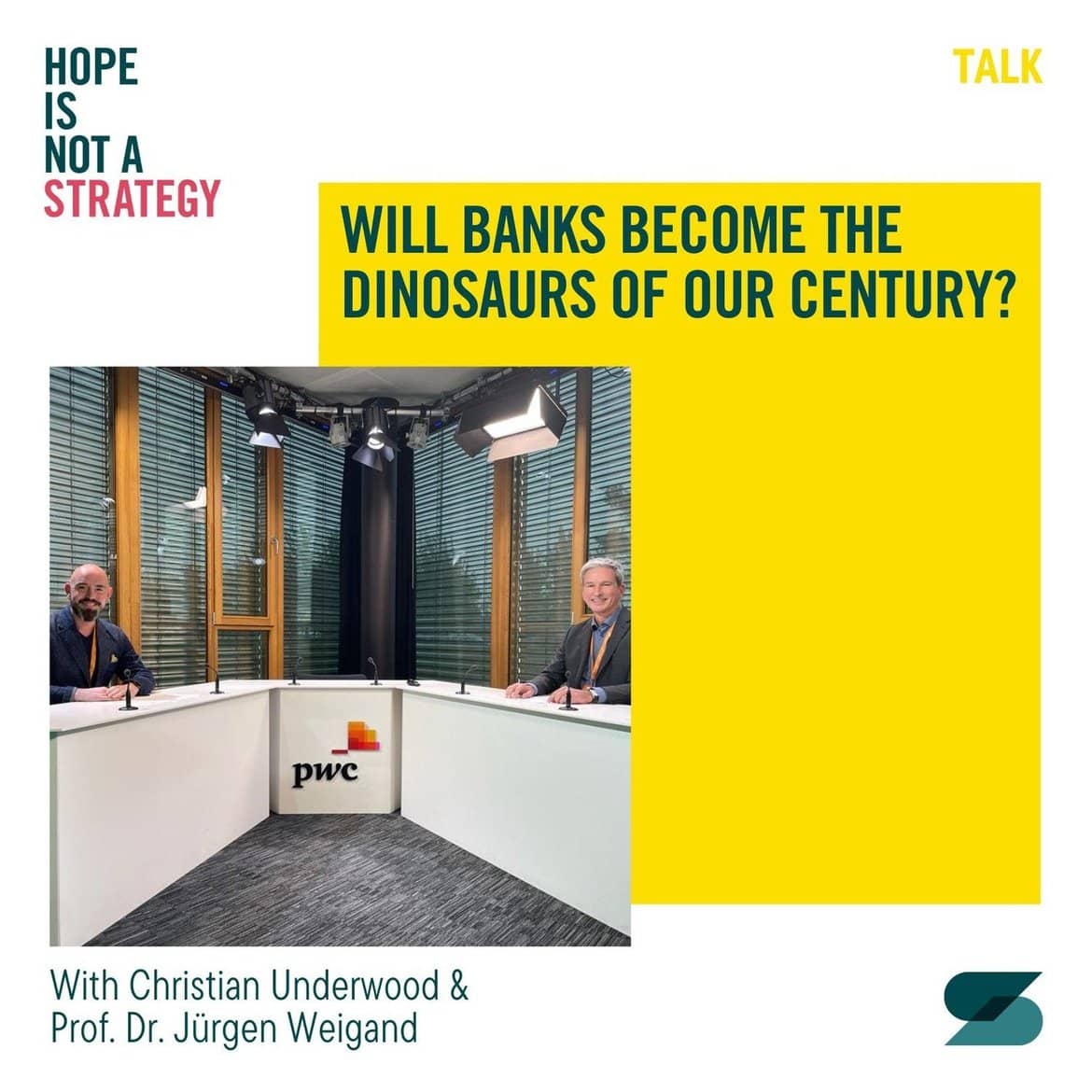
#30 Will banks become the dinosaurs of our century?
This episode was recorded in German.
Subscribe nowto our English podcast HOPE IS NOT A STRATEGYThis episode is our first live episode, recorded in Luxembourg as part of the Sustainable Banking Forum. Our thanks go to Daniel Theobald and Jörg Ackermann, who invited us and gave us the opportunity to share our thoughts on sustainability in the banking sector.
We share our insights on how sustainability can work in institutions. We also discuss whether banks are still in tune with the times and what challenges the banking sector has to overcome today.
Learn what new strategic approaches the banking sector could and should take, and get inspired to make a difference in this world.
How should sustainability work in institutions?A forward-looking direction for banks has never been more important when it comes to sustainability and ESG.
In Christian's opinion, climate change is the biggest market failure in history. The market, banks included, is the one expected to solve it today. The question, however, is this: Can banks invent something truly disruptive that changes the world for the better? Or do they create more harm than good by trying?
Jürgen's answer, from an economist's point of view, is as follows: Climate change is not a market. It is an external force disrupting many things in these times. It affects markets in ways we have not thought of before. The economic term externalities captures this well. It refers to things spilling over unintentionally. For the first time in recent history, global activities, and especially those of banks, spill over to a degree that endangers our planet.
Have banks thus done more harm than good?Banks have been bad-mouthed for their behavior, and the financial crisis of 2008 is just one example. Banks did not play the responsible role we would have expected.
Still, the history of banks dates back to the Middle Ages, when money changers took care of people's money somewhere in Italy. They helped travelers avoid risk. In that sense, they played an important role.Banks act as intermediaries; they ease and facilitate business. But that is also a problem for them, because their interim role makes them a target to be replaced and displaced. Technology also tends to disrupt the traditional banking industry. That challenges banks to develop a new and different approach. Holding an intermediary position in a digital age is a big obstacle to overcome. Stories like Airbnb or Uber have shown how technology disrupts existing business models. The big, traditional banks ought to think more deeply about that. Can they be easily replaced? Will anyone miss them if they are gone? Bankers will likely respond: "Of course we will be missed!" Jürgen doubts that, however. Things are changing so rapidly that we need some kind of plan, because hope is not a strategy.
Are banks capable of solving problems like sustainability for humanity? We cannot expect banks to be the drivers of change. Sustainability, like climate change, is a geopolitical issue. It has to be solved at the government level. From there, it cascades into the different areas of the broader system. Of course, banks still play an important role today as engines of the financial sector of our economies. But there is also the real economy, and that is where the pressure comes from. Governments are putting enormous pressure on the real economy, such as manufacturing industries, to achieve a balanced CO2 footprint. That's where it gets difficult. Banks, as financiers of the real economy, have to follow suit and develop their own strategies that align with what the real economy needs.
Is the current business strategy of banks still valuable for the future? We have to be clear about what we mean by banks here. When we talk about banks, we mean private or corporate banking. What is the role of banks in private banking? A private person puts her or his money in a bank account. Banks transform that into loans. There is a maturity transformation: banks borrow short-term and lend long-term. Private customers, however, need neither a bank with heavy overhead nor traditional branch offices. That is the legacy cost of the traditional banking industry. Banks have to find ways to
transform digitally
get it right on the people front (when a bank like Deutsche Bank lets 5,000 employees go, there is a big outcry in the economy).
Banks, especially German ones, face a lot of overcapacity in the market, with more players than they need. Real consolidation is badly needed and has not happened over the past few years. Governments bailed out well-known banks in Germany. There is an immense need for fundamental reforms.
Customer centricity in the banking sector: just a buzzword? Unfortunately, customer centricity is almost non-existent in the banking sector. Whatever is promised to private customers is not delivered, for whatever reason. That is disastrous. If traditional banks really want to move forward and survive, and if they do not want to become the dinosaurs of our century, they will have to come up with something that satisfies their customers. Otherwise, private customers will find other ways to meet their needs.
Sustainability and ESG: What strategic actions can banks take to put it into practice?There is no such thing as an ESG strategy on its own. Something overarching is required, and that is what we typically call a business or corporate strategy. The ESG criteria have become so important that you can no longer ignore them. It is not enough to jump on a bandwagon and run behind people who only promote ESG. For banks, there are three main areas of action:
Avoiding bad things that do not fit the ESG matrix.
Promoting positive things that have a good impact on the ESG matrix.
Driving change.
As stated above, banks are not the driver of change, but they CAN be a driver of change. As facilitators of business, banks can act as catalysts. They have clients they need to align with, because those customers need ESG as part of their overarching strategy. So banks can implement it for themselves as well.
Promotion and change instead of avoidance as a strategyStrategy is all about being proactive, not waiting for things to happen. It is about looking ahead and anticipating developments as well as the consequences of change. The key is promotion and change rather than mere avoidance. A proactive approach for banks would be to talk to their clients and ask what they expect. Customer centricity, or better put, stakeholder centricity, has to be lived.
Given their past role, will banks become the yardstick for responsible corporate governance? This applies regardless of the line of business. Banks have to be responsible for what they are doing and what they will do. The social component matters, because we live in a social market economy. What needs to happen on the banking side is resolving customers' concerns about paperwork. Banks need to explain and help customers understand what they can and must do. Banks should build a kind of information advantage and turn something that challenges them, and that they don't like, into an advantage.
Strategic levels beyond ESG and sustainabilityBesides ESG and sustainability, there is also the risk strategy of banks, as well as their product strategy, business strategy and corporate strategy. If banks haven't dealt much with sustainability in the past, how can they now get in tune with the times and become sustainable?Banks, like any other leader or business owner, need to develop a sense of urgency for sustainability, with a long-term perspective that reaches beyond their own tenure. ESG is something everyone has to invest in. That is non-negotiable.
How can banks enable their customers and provide security in these unstable times? To answer that, you need to distinguish between private and corporate banking. Private customers need a trusted advisor on the banking side who is not out to take advantage of them. The corporate level needs transparency and honesty. In closing, Jürgen says that if you really want to make a difference in this volatile and uncertain world, you have to walk your talk. Be clear about your organization's purpose. What good do you want to do for the people out there? What is your real impact on the environment and society? We need excellent leaders who take good care of both their clients and their employees, and who understand: responsibility also means accountability.
Shownotes:
Christian Underwood:https://www.linkedin.com/in/christianunderwood/
Prof. Jürgen Weigand:https://www.linkedin.com/in/j%C3%BCrgen-weigand/andhttps://www.juergenweigand.com
Underwood GmbH:https://www.underwood.de
Hope Is Not a Strategy:http://www.hoffnungistkeinestrategie.de
Daniel Theobald:https://www.linkedin.com/in/daniel-theobald-llm/
PWC Luxembourg:https://www.pwc.lu
Preorder the book Hope Is Not a Strategy here:https://www.underwood.de/buch
Contact: Need help with business strategy or want to give us feedback? Then please contact us at info@underwood.de. We look forward to hearing from you.