

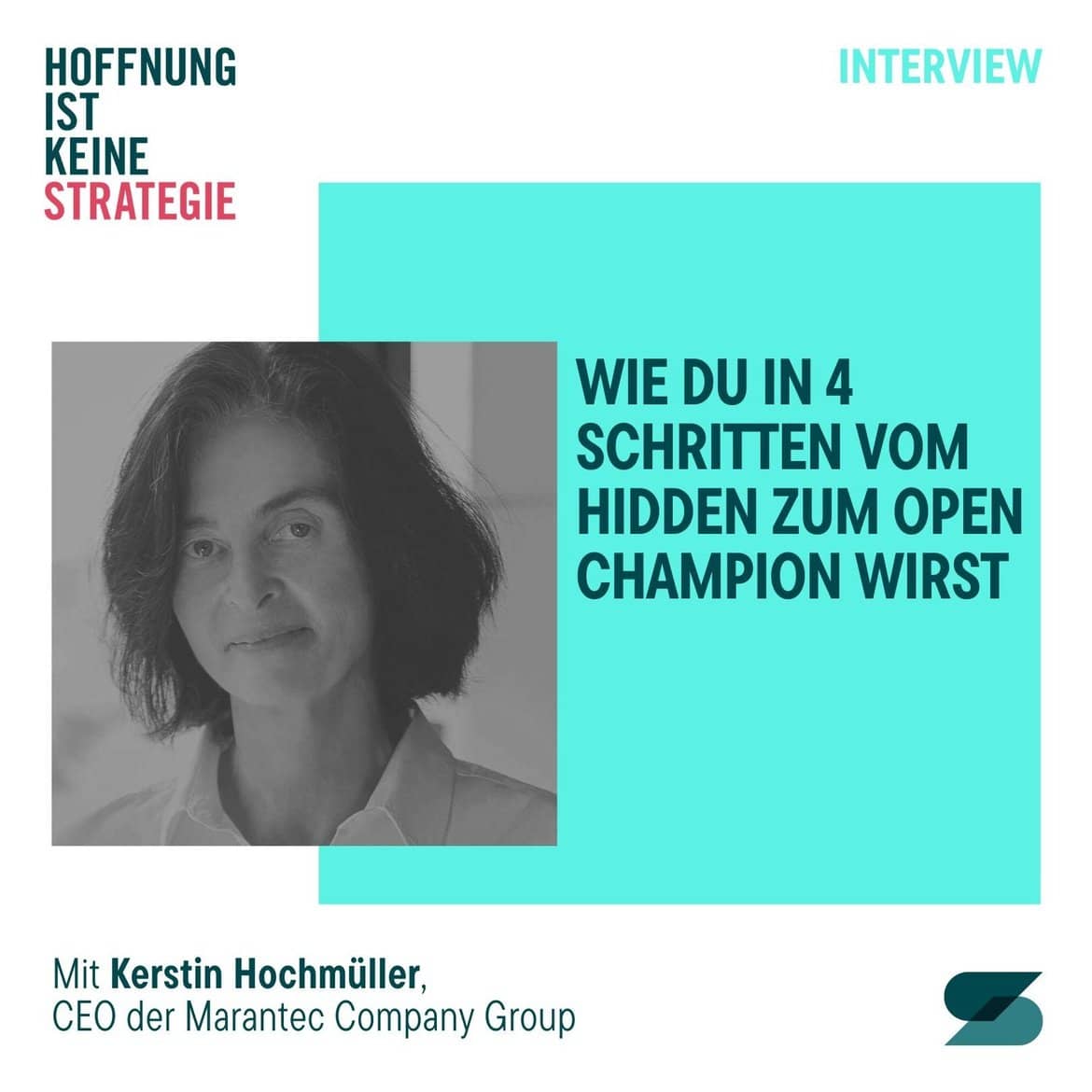
#10 How to go from hidden to open champion in 4 steps
This episode was recorded in German.
In this episode, we talk with Kerstin Hochmüller about how to lead a genuine mid-sized company from Eastern Westphalia into the future, why secrecy is no longer a recipe for success for hidden champions, and why more German mid-sized companies should follow the example of the open champion. Mid-sized companies are considered the backbone of the German economy. Given the challenges of today and tomorrow and their impact on business models, the secrecy has to go. Anyone who still wants to move things forward in the future should be open and deliberately seek out exchange. Too often you hear from companies: "We have plenty of ideas of our own." But Kerstin doesn't believe those ideas are good enough to meet complex challenges successfully. That's why she is firmly convinced that honest, open exchange among mid-sized companies, combined with start-ups, is essential for creating unique innovations. On that basis, the open champion method emerged during her transformation journey. It rests on four pillars: 1. Take the best of the hidden champion and stay a champion. 2. Open innovation: innovation doesn't just happen internally, it is developed above all with external partners. In Kerstin's experience, the innovations then become bigger and better. 3. Cooperation: collaboration has to happen as equals, and everyone involved should get something out of it, a real win-win. 4. Leadership: everyone in the company should be empowered to act with ownership and an entrepreneurial mindset. How exactly Kerstin launched the open champion method at the Marantec Company Group, why she didn't want to change the company culture to do it, and what it means to her to be the coolest company for high-performance drive systems: find out in our new episode of HIKS, "We are open champions." Detailed content of this episode: In this episode, Christian Underwood talks with Kerstin Hochmüller, CEO of the Marantec Company Group, about the journey from hidden champion to open champion. The starting point at the Marantec Company Group: The Marantec Company Group is a mid-sized group of companies from Eastern Westphalia that specializes in high-performance drive systems and operates in 70 countries. Eight years ago, the previously classic company structure, consisting of two managing directors who ran the business operationally, was gradually opened up and layers of hierarchy were removed. The focus was on building breadth and running the business together instead of placing responsibility on a single person. The goal: become the coolest company for drive systems, with an ecosystem of start-ups and mid-sized companies that learn from each other. First, Kerstin Hochmüller defines "cool" more precisely. For her, "coolest company" means that your own employees enjoy working in the company and can contribute and develop. Cooperation partners and clients should also feel good about working together. When choosing where to work or who to work with, stakeholders should pick the coolest company. What matters most to Kerstin is meeting each other as equals. This mindset of networks and cooperation shouldn't just be lived inside your own organization, it should also be carried outward. In collaboration, the main focus is on looking at what you can do together. Anything that keeps you from working as equals should be eliminated. Secrecy doesn't get you anywhere: the foundation in many family businesses is trust. The whole workforce is a family and people treat each other with trust. Even so, there are secrets, because you don't want to tell everyone everything, since you usually don't know what the other person will do with the information. To minimize secrecy in the company, leaders should go first and share information. So in the beginning they shared a great deal in order to break down silos. Topics included which projects the group was working on, how things were meant to be built, and how they envisioned working together. What was being lived internally was then carried outward. Their own strategy: open champions, and how it works. The open champion method emerged along the transformation journey and was inspired by the hidden champion. The Marantec Company Group wants to take the best of the hidden champion and, of course, stay a champion. But "hidden" wasn't the way they wanted to keep innovating in the future. The development took several years, and things were adjusted along the way whenever necessary and something needed improvement. The open champion method now rests on four pillars: 1. Take the best of the hidden champion and stay a champion. 2. Open innovation: innovation doesn't just happen internally, it is developed above all with external partners. In Kerstin's experience, the innovations then become bigger and better. 3. Cooperation: everyone involved in a collaboration should get something out of it, a real win-win. 4. Leadership: everyone in the company should be empowered to act with ownership and an entrepreneurial mindset. On a scale of 1 to 10 (10 = open champion), how far along is the Marantec Group? Kerstin jokes that it depends on the day. On some days you think everything is fantastic and you're at a 10.5, and the next day you think, "Okay, it's more like a 2." You can always get better and it moves in waves, but realistically they are now far enough along that it can't tip back. From a realistic perspective, Kerstin puts it at a 5. Can and should you change the company culture? Kerstin describes changing culture as nearly impossible. She also questions whether it's even desirable. After all, there are employees who have been with the company for a very long time, and they too need to be valued in their culture and in the work they have done so far. That's why Kerstin prefers to talk about changing the mindset. She describes mindset as the rules of working together: the rules you want to work by and the rules that apply when you want to decide something and help shape it. That way, every employee can live the culture they feel comfortable in, the past can be honored and the future lived at the same time. The most important rule here: tolerance. Talents are allowed, but no putting others down. There's no "we don't listen" because someone didn't go to university or anything like that. Everyone is heard and every idea gets a hearing. So her message to every business owner is to work on the mindset, not on the culture. Who do you involve in the important topic of strategy? In this model, the strategic part is like a frame, a vision. Who do we want to be? How do we want to be, and which business areas do we want to work in? The frame is defined and then communicated into the organization. In principle, anyone can then take part in developing the strategy. Leaders then check whether the results fit the frame. A similar principle applies to projects. Projects are, in a sense, put out to tender. The leaders already have in mind who the project would suit best, but they always stay open if someone wants to join in. Here too, the flow of information is especially important. Regular check-ins and sharing information remain the key. After seven years of experience, what would Kerstin do differently if she could start over? Speed as a value in itself: she would do everything much faster and spend less time on culture. Instead, she would pour a vision into the mindset. She would be less patient about giving leaders time to take it all on. She would also put together a team to support the whole thing more quickly. The most important tips at a glance: mid-sized companies are the backbone of the German economy. That's why, for Kerstin, collaboration among mid-sized companies combined with start-ups is essential. If everyone works on their own, a lot of money is lost. To be ready for the challenges of today and tomorrow, you have to give up the "we do everything ourselves" tactic. You should learn that there's nothing to lose and a great deal to gain. "We already have enough ideas of our own" is a sentence you hear very often. But Kerstin doesn't believe that the ideas you come up with alone are good enough to solve the problems in this world. That's why she values open, honest exchange. Business owners have to start taking on that responsibility. If you take over a company, you should feel obliged to shape and build, not to administer. You have to want to change something and bring ambition and the will to get things done.