

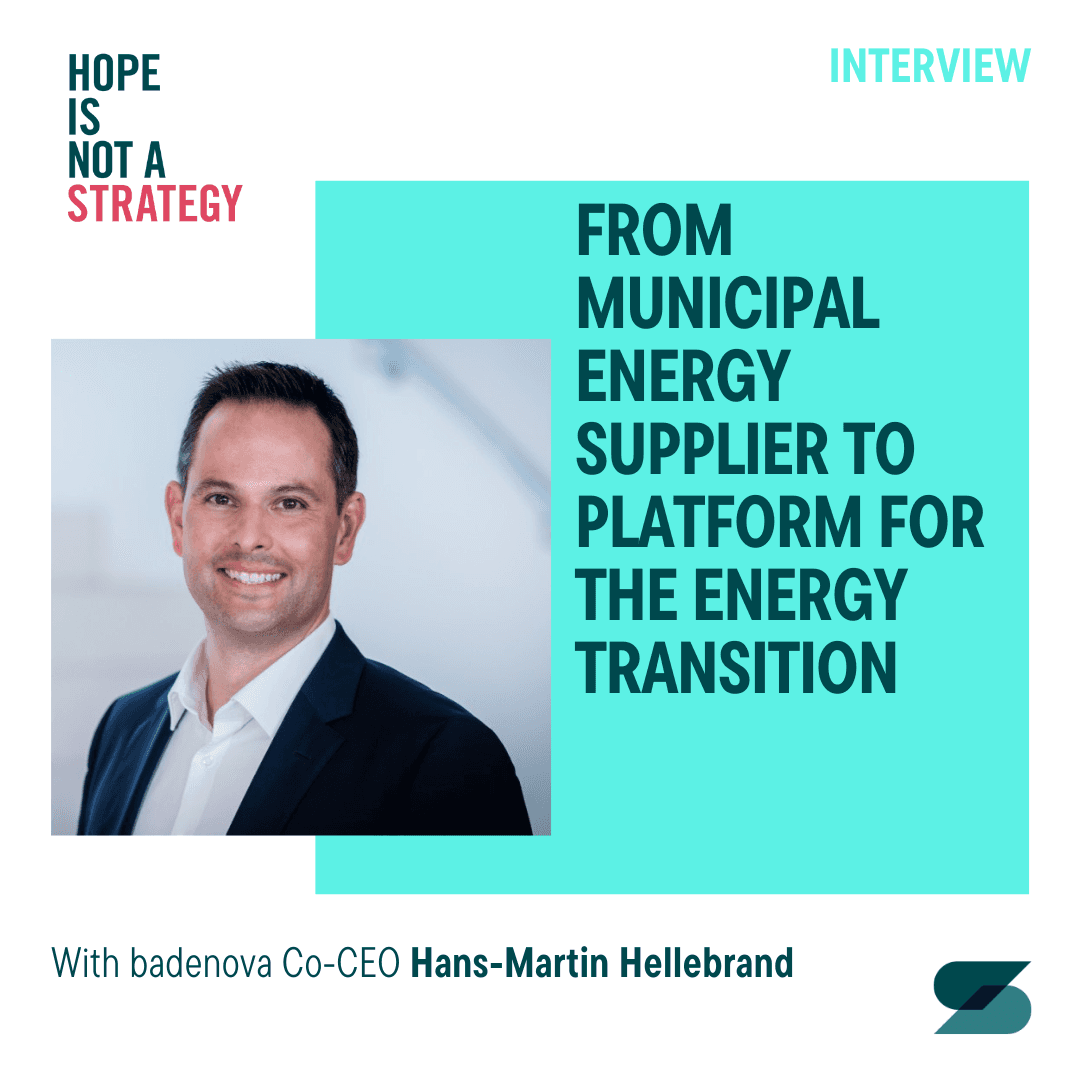
#06 From municipal energy supplier to platform for the energy transition
In this strategy interview, badenova Co-CEO Hans-Martin Hellebrand describes the two-year journey of a municipal energy supplier with more than a century of history toward becoming the digital platform for the energy and heating transition in southern Germany. Christian Underwood and Prof. Dr. Jürgen Weigand get to the bottom of what made this strategic realignment work: a participative strategy process, shared leadership at the very top of the company, and agile goal management with Objectives & Key Results (OKRs).
From IT controlling to an innovation lab in Silicon Valley to the energy supplier
Hellebrand's remarkable career includes a business administration degree from the University of Bielefeld and his start in controlling at RWE Systems in 2006. As his responsibility and leadership scope grew, he was eventually appointed Senior Vice President Group IT Controlling. His passion for innovation and technological progress took him to Innogy as SVP Global Innovation & Cooperation, where he played a key role in founding and building the InnovationHUB in Silicon Valley. Along the way, he completed his Executive Kellogg-WHU MBA and the CIO program at WHU. After three years in the U.S., he returned to Germany in 2018 to support the growth of the energy discounter eprimo as Managing Director. His passion for digital transformation in the energy industry finally brought him to badenova as Co-CEO in July 2021.
Vision: shaping the energy and heating transition for a future worth living
"We are shaping the energy and heating transition for a future worth living. With the region, for the region." That is the company's WHY. But what does it mean in practice? Hans-Martin Hellebrand explains that badenova's mission is to shape the sustainable energy world of tomorrow. That includes every aspect of the energy world: the transformation of the entire energy system and water as a vital source of energy. A particular focus lies on tackling this goal together with the region, for the region. Transforming the energy system requires many stakeholders to work together; it is not in the hands of the energy supplier alone. To make that collaboration work, badenova, in addition to its classic mandate to supply sustainable energy, heat and water, organizes energy solutions for private households on a digital end-to-end platform. This way, all the partners needed for the decentralized energy transition at the customer's site are brought together into one holistic offering.
"We all have to pull together to make the energy transition possible."
Hellebrand points out that badenova's target image is based on Simon Sinek's "Golden Circle." It answers the questions: Who are we? Where do we want to go? The term "target image" (rather than "purpose" or something similar) was chosen deliberately to make the core idea easier for employees to grasp: the target image gives everyone a point of orientation, along with the energy and confidence to move forward every day.
He explains that their goal is to shape the energy future by moving away from today's fossil fuel system toward a better one, but without being dogmatic about it. They want to take their customers along on that journey and help them make the best possible transition to sustainable energy.
Innovation and digitalization offerings in badenova's portfolio
Christian wants to know whether Hellebrand's time in Silicon Valley has translated into innovative, digital product ideas for badenova. Hellebrand starts by explaining that badenova has a strong innovation DNA in its blood and has had the ambition to change the world for years. When badenova was founded, for example, an innovation fund was set up in which a share of the shareholders' annual profits goes into promoting innovative projects in the region.
Hellebrand then turns to concrete innovative solutions badenova is already implementing, some of which could easily have come out of Silicon Valley. One example is the platform-driven ecosystem approach to the decentralized energy transition for private customers. The idea is to understand customers' needs and their infrastructure in order to find the optimal energy solution for each of them. The platform brokers solar systems, batteries and other products from hardware manufacturers, while regional tradespeople handle installation and maintenance. badenova also works with partners such as building societies and banks to secure financing.
Hellebrand also emphasizes that badenova focuses clearly on its core competencies here: the relationship with its customers and its expertise in energy. In the search for the best solution, however, working with partners and experts is essential to arrive at a holistic answer. Hellebrand calls it an "Uber or Airbnb approach" in the energy sector, and stresses that badenova's ambition to pioneer energy innovation goes well beyond it.
From Silicon Valley to badenova: German mid-sized companies can keep up
His passion for IT and innovation took Hellebrand to Innogy in 2015 as SVP Global Innovation & Cooperation, straight into the heart of Silicon Valley. For three years, he drove the founding and development of the InnovationHUB there. Despite the cultural differences between Silicon Valley and a down-to-earth, traditional company like badenova, he felt at home from the start and was warmly welcomed. He describes Silicon Valley as an entrepreneurial environment where you take on a lot.
"Compared with much of my experience in large corporations, the attitude and mindset I find in mid-sized, regional and municipal companies is far closer to Silicon Valley than anything in a big corporation."
Designing the strategy process participatively
Hans-Martin Hellebrand joined badenova only two years ago, and together with his co-CEO and the entire team, he managed to realign the company strategically from the ground up in that short time. A remarkable track record. So how did he approach this transformation to get those results?
First, they defined a target image to have a point of orientation for everything that followed. It was important to them to involve the entire company, gathering input from every level of the hierarchy and choosing a participative approach. The aim was to arrive at an image everyone could share and that would act as a driving force. This target image was then developed iteratively and ultimately used as the north star for the strategy work.
From there, concrete courses of action were identified that lead toward the goal, such as rethinking the gas network or building a decentralized energy future for customers. Hellebrand stresses how important it was that every employee could identify with the process and take ownership of their own work. The participative approach and the joint work on the target image made that possible.
How badenova uses shared leadership and OKRs
Does a company really need one person as the main decision-maker to be successful? badenova proves otherwise. Hellebrand describes its governance structure as a two-person board with no primus inter pares. Instead, he runs the company as a team with his colleague Heinz-Werner Hölscher, with neither of them having more say than the other. Each has focus areas, but they carry entrepreneurial responsibility for the whole.
badenova also relies on a methodology called OKRs (Objectives & Key Results): at the start of each four-month cycle, the company sets concrete goals in the form of tangible, desired outcomes to work toward within that period. What matters here is dialogue-based collaboration within the team on the way to achieving the goals in a sprint, plus a retro and review at the end of each cycle to keep improving.
The result of this model is dialogue-based collaboration and much stronger involvement of employees in decision-making. It also builds a culture of cooperation and teamwork across the entire company.
badenova introduced the methodology in a very low-threshold way, starting by defining the "top issues" for the next sprint together with the teams. That made the value of the method immediately clear, and only in the following sprints was the now established way of thinking refined step by step.
Hans-Martin Hellebrand's advice of the day
Christian concludes by asking which skills are now really crucial to be successful in a constantly changing environment. In summary, Hellebrand's time in Silicon Valley taught him to always look outwards for change and opportunity and to have the courage to implement new ideas and concepts. Even if they come with a certain risk of failure. In conclusion, he emphasizes that learning from mistakes and adapting strategy are crucial to achieving lasting success in a constantly changing environment.