

From hidden champion to stock market star
PFISTERER goes public on the Frankfurt Stock Exchange: a milestone in a successful transformation and strategic realignment.
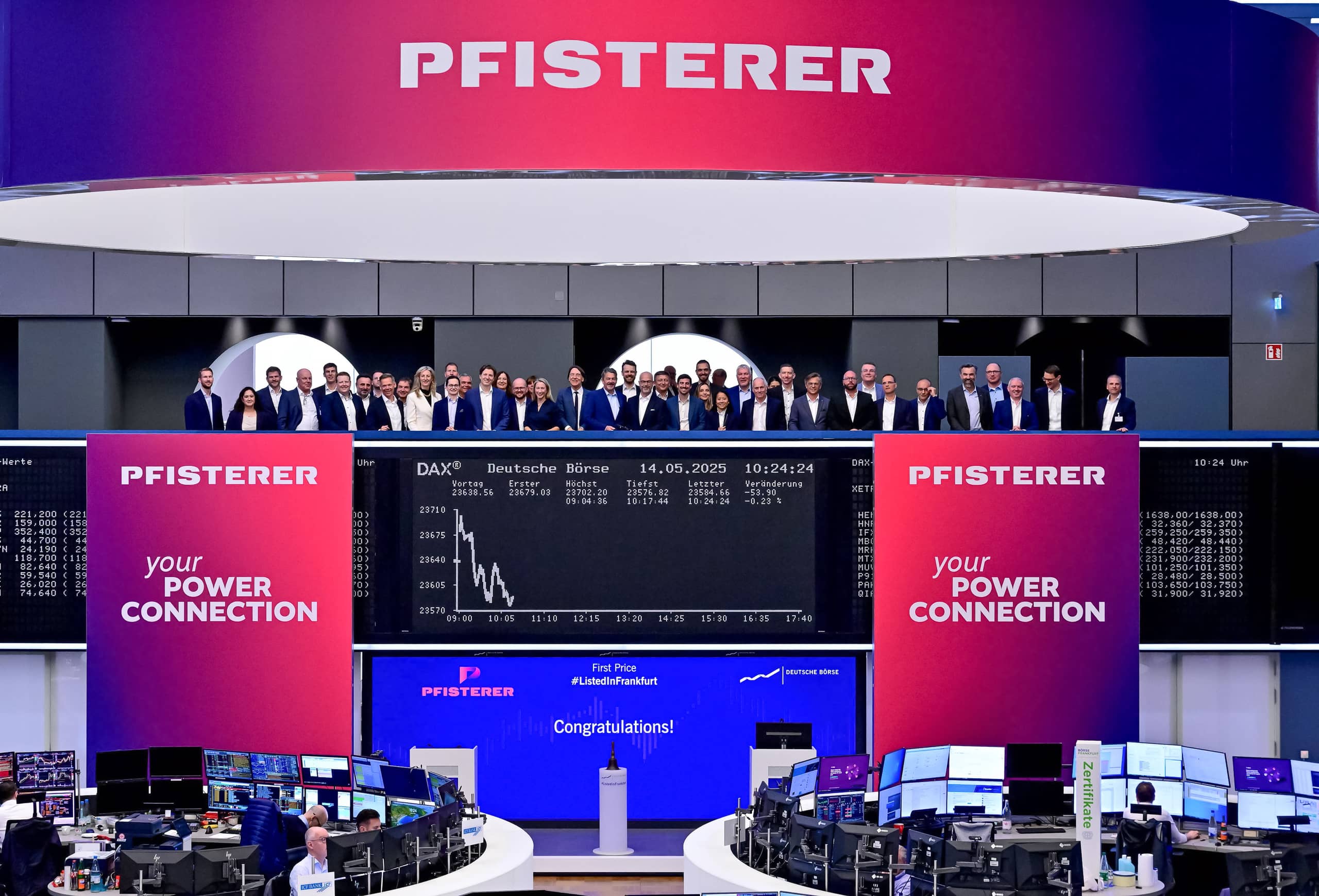
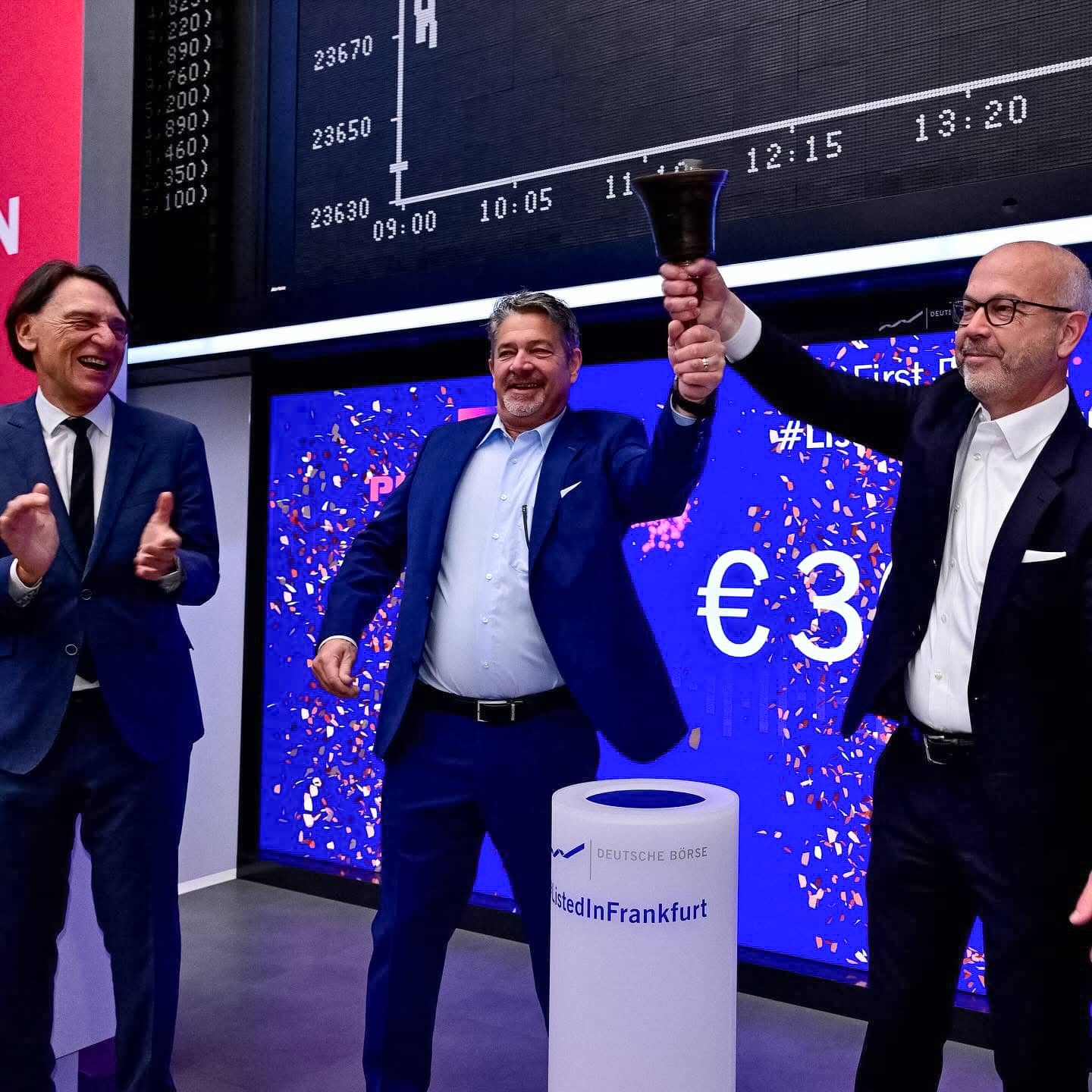
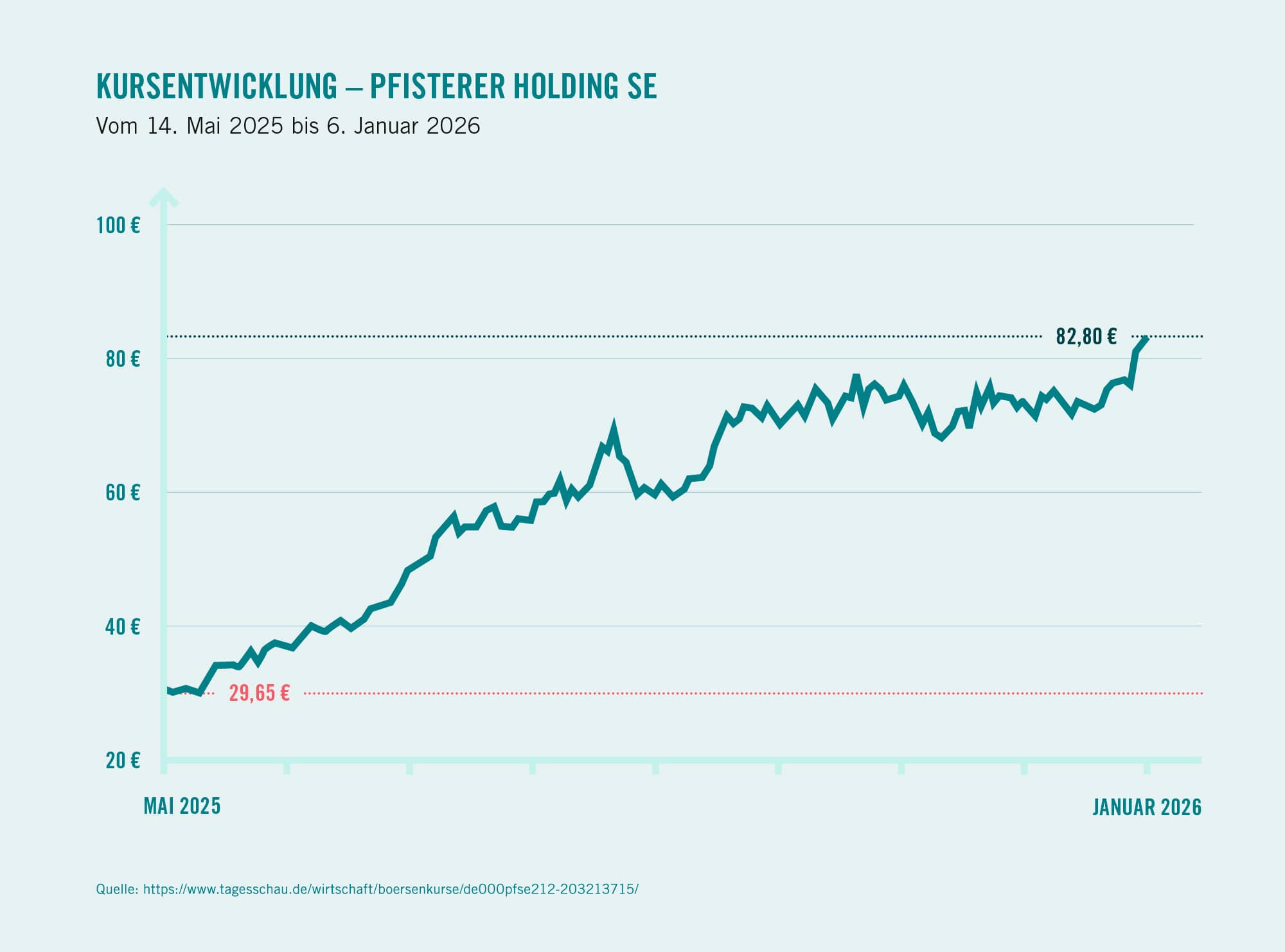
Headquartered in Swabia, technologically leading, and for a long time known only to people who deal with electrical engineering and power supply for a living. May 14, 2025 was the day that changed for good. "PFISTERER's IPO a success," reported Tagesschau, and Handelsblatt ran a headline on the technology company's "strong stock market debut." PFISTERER, which specializes in technology for connecting and insulating electrical conductors at interfaces in power grids, had landed the IPO of the year: the first IPO by a German company at all in the turbulent year of 2025, read as an encouraging signal for the entire European IPO market. The opening price of the share in the Scale segment of the Frankfurt Stock Exchange was already well above the issue price, and its performance has exceeded all expectations since. That was no coincidence, but the result of consistent strategy work that the capital market rewarded. With an additional €95 million in capital raised in the IPO, PFISTERER is ideally positioned for the future.
Pole position for the transformation of the energy supply
Only a few years ago, none of this was a foregone conclusion. Acquisitions intended to round out the product portfolio horizontally had not paid off. Complex IT projects and production relocations, once accompanied by high expectations, had driven up costs and unsettled the workforce. Once the restructuring was complete, it was clear in 2022 that new funds were needed to create more room for investment. Key technology customers had made it plain that they intended to grow ambitiously themselves, and that they needed equally strong partners to do so. "They clearly wanted us to walk that path with them as a key supplier," says Dr. Konstantin Kurfiss, Board Member for Sales and Technology. The best solution for the company to put itself on the right financial footing: an IPO that opens up access to growth capital without giving up entrepreneurial independence. PFISTERER is to remain independent. Karl-Heinz Pfisterer took on that mandate from his father, and independence remains at the core of the company's identity.
Above all, though, the company needed a coherent new strategy that would bring leadership team and employees back together behind a shared goal and get them excited about it. Excellently connected internationally and successful in numerous energy supply markets, PFISTERER was still sitting on untapped growth opportunities. The global hunger for electricity, the energy transition, and the growing awareness of how essential stable grids and security of supply are for that transformation put the company in pole position. But where should it focus, and which levers should it pull to grow sustainably and profitably?
Building confidence in your own strength
"It mattered to us to keep our hands on the wheel instead of letting external consultants set the course," explains Patrick Weng, Head of Strategy at PFISTERER. "All the more so because the team needed to rebuild confidence in its own strength." After completing the StrategyFrame® Academy himself, Weng launched a trial balloon: a strategy process for PFISTERER's medium-voltage segment, which plays a key role at the interface between power distribution, switchgear, and decentralized energy infrastructure. The product and sales teams pooled their expertise and defined core goals such as opening up new business areas through an expanded product portfolio and expansion into additional world regions. "Tackling a pilot first, before the big picture, was exactly the right approach for us," says Weng. In earlier strategy processes he had often found it difficult to integrate colleagues spread across the globe into one central process. This time it was comparatively easy: "The StrategyFrame® creates confidence because the framework is simply set. That allowed us to move forward quickly."
Transporting electricity across the continent
While preparations for the IPO moved ahead inside the company, the second stage of the strategy work kicked in from spring 2024. The central challenge: anchoring a new, shared spirit across the entire leadership team, based on the firm conviction that the company can consistently seize the growth opportunities in the market. To do that, the management team first developed a well-founded situation analysis, complemented by an external market study and additional market and competitive analyses.
Individual target pictures, but no integrated overall picture yet
It quickly became clear that the individual functions and business units had quite clear ideas about where the particular growth opportunities lay in their respective fields, and what individual target pictures derived from them might look like. The consensus was that every region has to orient itself clearly toward the local requirements of its markets. In the energy sector, shaped so strongly by politics and regulation, that is indispensable: the requirements that apply in the US, for example, can differ enormously from those in the Middle East. What was missing, however, was an integrated picture for the company as a whole. PFISTERER's individual capabilities would only unfold their full competitive impact if they were not viewed in isolation, but consistently aligned with one another and thought of as a connected system.
A deep understanding of customer applications
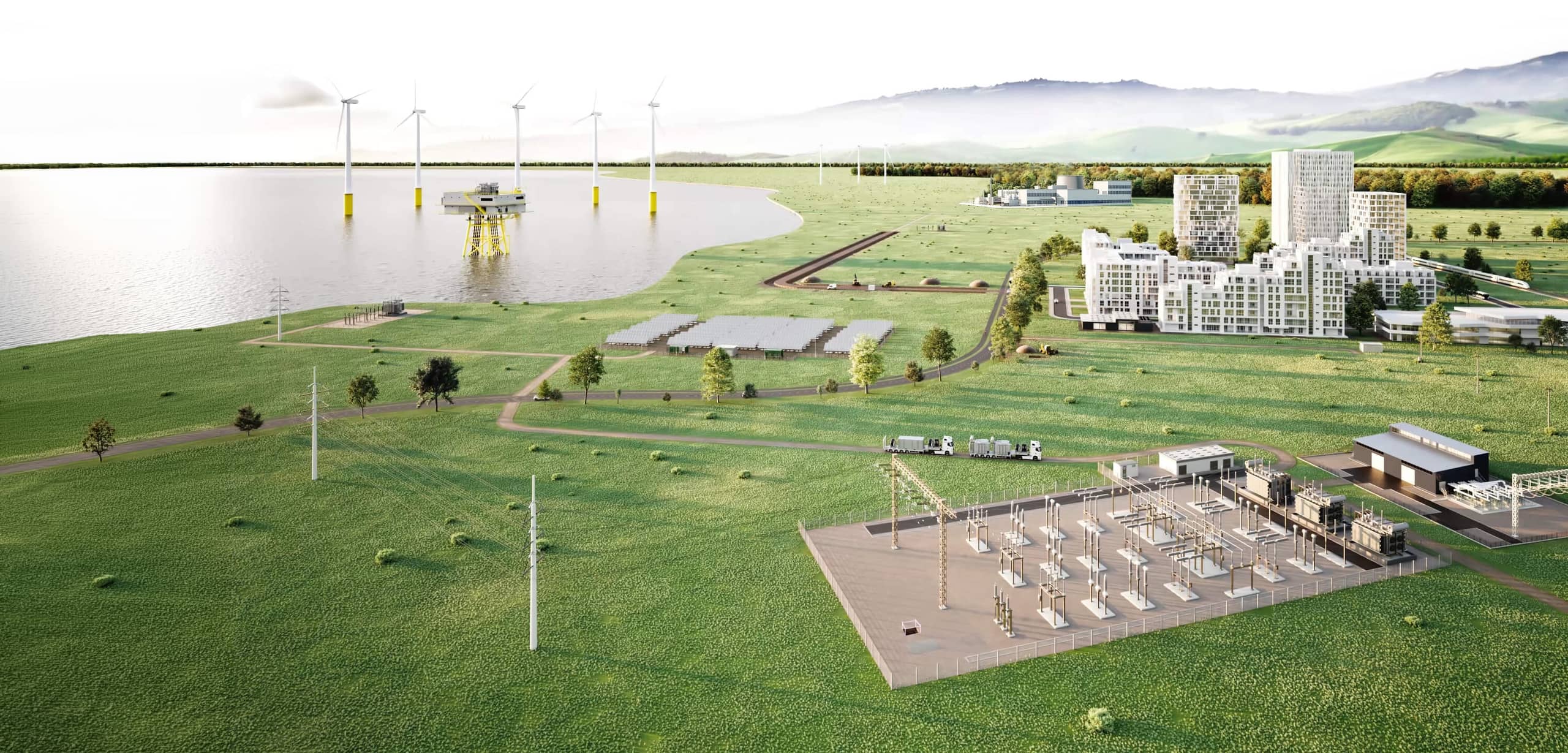
The company has a unique combination of strengths. As a globally active, independent supplier, PFISTERER covers applications underground, such as buried cable systems, just as much as overhead lines in the air. Connecting and insulating are decisive core competencies, complemented by deeply rooted expertise in processing materials such as metal and silicone and by dedicated testing capacity. Relationships with customers such as major OEMs and grid operators are marked by a closeness built over decades, combined with a deep understanding of their applications. It is the targeted interplay of these specific capabilities that makes up the company's strategic strength. New products point the way, for example the pluggable connection system for so-called clean air switchgear that PFISTERER developed for Siemens Energy. Instead of conventional insulating media, clean air relies on natural components of ambient air, making a major contribution to climate-friendly power transmission and distribution.
"The strategy was a decisive support in the IPO process"
A broadly staffed, cross-functional team worked out what the company would tackle in each action area to build on such successes and reach its target picture. Deliberately without defined OKRs at first, so as "not to overload the organization in the middle of the IPO preparations," says Weng. Everyone involved knew that this decision would mean additional rounds of work. Today, the goals defined for each action area are backed by clear metrics, the projects are in execution, and those responsible report regularly to the Executive Board. "The clean and coherent preparation of the strategy was a decisive support throughout the IPO process, especially in formulating the equity story," says Johannes Linden, Spokesman of the Executive Board. "It contributed enormously to the fact that both the lead banks and the investors believed in the success of the project."
Targeted investment in development and testing infrastructure
PFISTERER is investing the funds raised on the capital market along all strategic thrusts: strengthening its core markets, expanding adjacent business areas, and targeted investment in innovative technologies for the global energy transformation. That includes consistently strengthening its core technological competencies as well as deliberately expanding regional proximity to customers and applications, for instance through a stronger presence in high-growth regions such as the Middle East. In parallel, the company is focusing on technological developments that will shape the electrification of energy infrastructure over the long term.
Positioning as a complementary technology partner
PFISTERER plays a special role, especially in cable accessories and connection solutions: leading cable manufacturers rely on its solutions so they can focus on their core competence, cable production. That strengthens the company's position as a complementary technology partner at key interfaces of modern power transmission systems. To make even better use of the opportunities this role offers, PFISTERER is expanding its own development and testing infrastructure. At its headquarters in Winterbach near Stuttgart, a test laboratory for high-voltage and direct-current technology is being built, with a total investment of €20 million. "Labs like this are rare worldwide," Patrick Weng explains. "By building capacity ourselves, we become independent of others and create the infrastructure we need to execute the strategy."
Underground, in the air, and now underwater
Strengthening PFISTERER's unique positioning and investing in ways that sharpen it further: that's the company's guiding principle for acquisitions, too. Take Power CSL, an independent British specialist offering connection and repair solutions for subsea and submarine cables. Exactly the kind of products that ideally complement PFISTERER's expertise in underground and overhead applications. That's why a long-standing partnership with the British company turned into an acquisition last year: in April 2025, PFISTERER took over Power CSL in full. With combined forces, a world first came to market at almost the same time, developed for transmission system operator TenneT: a one-size-fits-all solution that connects a wide range of high-voltage AC submarine cable types using a plug-in principle, regardless of design or manufacturer. This makes it possible to repair damaged submarine cables even more efficiently and to keep spare parts inventories to a minimum. With the Power CSL acquisition, PFISTERER has set the stage to capture the growth opportunities in this market even better.
Every manager knows the big picture

Full order books and sharply rising revenues: it's already clear that PFISTERER's new strategic focus is paying off. Patrick Weng sees the close link between strategy development and execution as the reason this happened so quickly. "We placed a lot of emphasis on communication in particular, and on everyone participating actively." PFISTERER has completed two waves of activation across the entire company. "By now there really isn't a single manager on the team who hasn't been involved at least once and doesn't know our big picture." The fact that the new strategy came out of the team itself, supported by coaching and external facilitation only where needed, has proven its worth. "Of course we keep adjusting; the transformation of the energy market depends on many different variables," says Patrick Weng. "But we now have the tools we need, and the commitment of all stakeholders to keep going down this road."
About the author of the case study
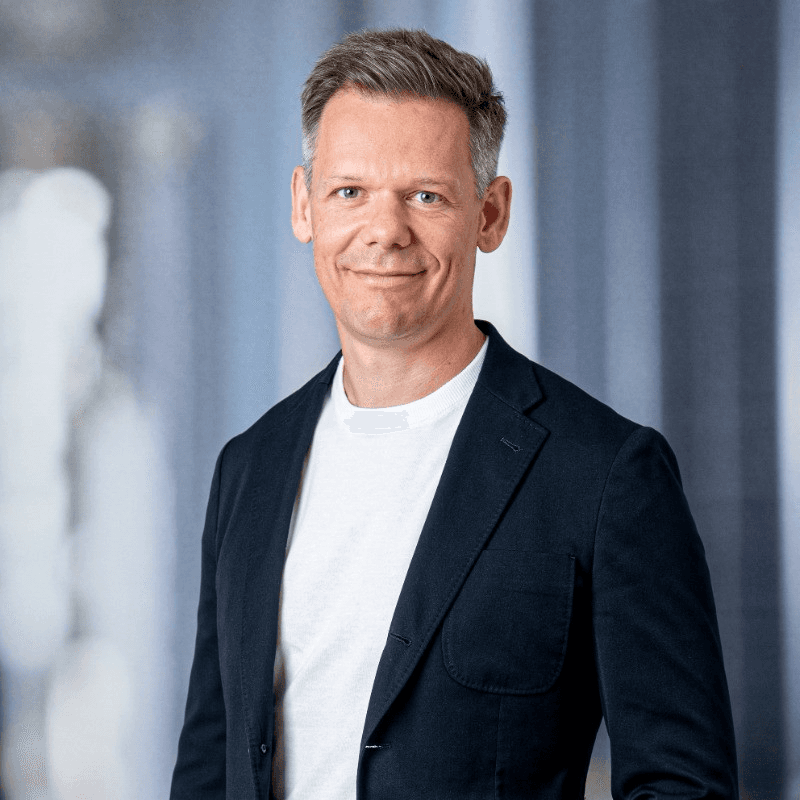
Patrick Weng is Head of Strategy at PFISTERER, where he shapes and steers the company's strategic direction. His focus is on developing and executing growth and competitive strategies as well as on M&A processes. He led the internal project management for PFISTERER's IPO. He brings more than 18 years of professional experience in consulting, banking and mid-sized industry.
Images:
- Martin Joppen/Deutsche Börse pp. 50/52
- www.landscape.pfisterer.com