

Fabromont:
Master of the super niche
Focus instead of breadth: the strategy of Swiss textile flooring champion Fabromont.
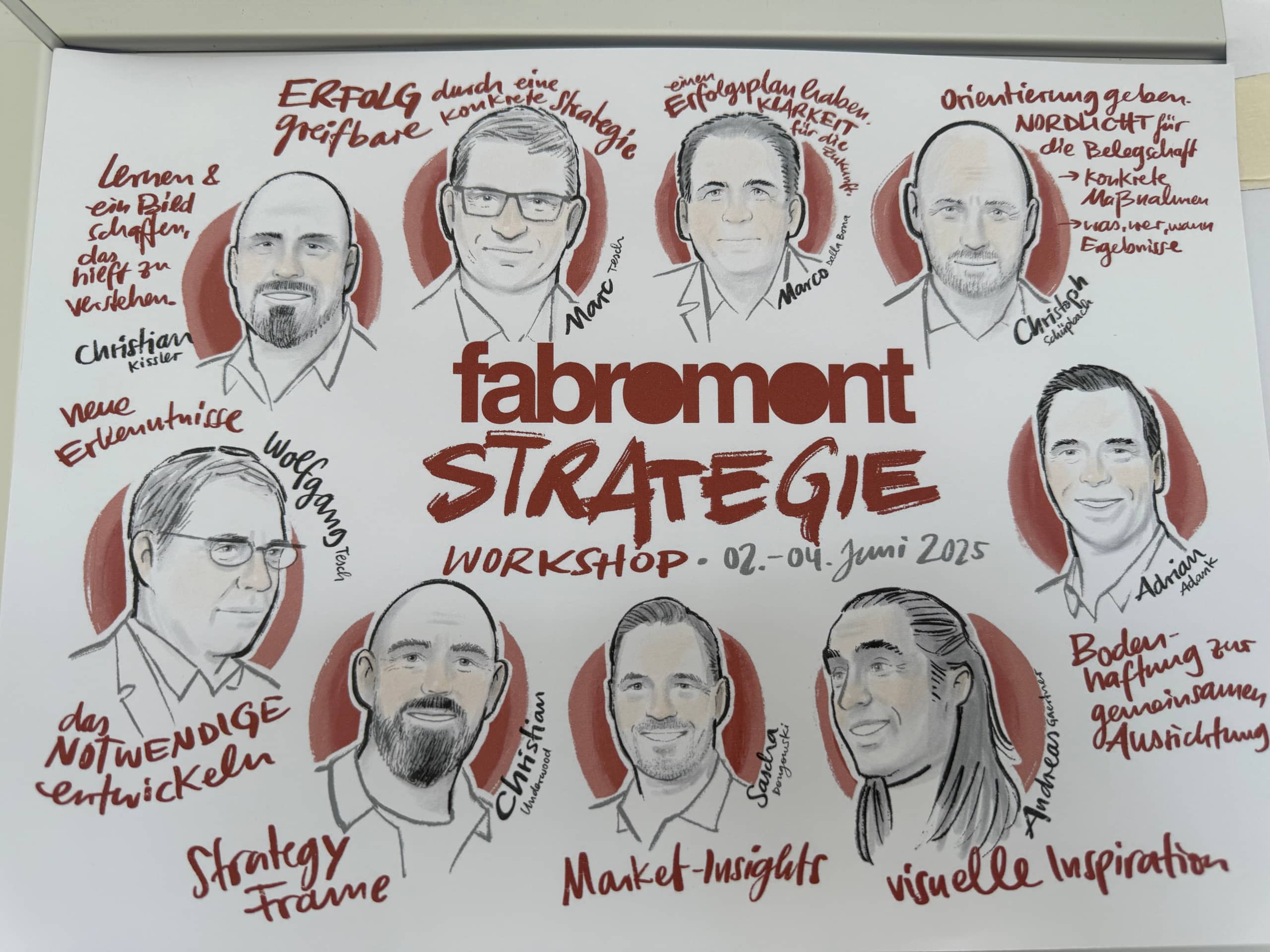
He's a Porter fan at heart, fascinated by the macro- and microeconomic rigor and the interlocking frameworks of American strategy guru Michael E. Porter: Five Forces, value proposition, value chain and much more. After earning his EMBA/MBA, Marco Dalla Bona even taught university seminars on the famous economist's approaches on the side, based on a practitioner's guide to Porter he developed himself. But build the strategy for Fabromont AG, which he took over as managing director two years ago, with models like these alone? "That only works up to a point for a mid-sized company like Fabromont," says the plastics technologist and mechanical engineer. "I've had the chance to set up and implement corporate strategies several times. So it was clear early on that we needed a framework that is scientifically grounded and at the same time lean and close to practice." That the textile flooring manufacturer in Schmitten, Switzerland needed a new strategy was beyond question, at the latest once Dalla Bona took office in 2024. Fabromont, founded in 1963 by textile engineer Günter Tesch, has been successful for many years with a unique product. Kugelgarn®, spun from a mixture of various fibers, is a product category of its own in the world of textile floor coverings. No competitor worldwide has managed to copy the patented and largely automated manufacturing process. "But the organization had been performing below its potential, because the clear focus was missing," says Dalla Bona.
Unbeatable for high-traffic spaces and walking comfort
The owner, the board of directors and the other members of the management team were quickly convinced by his idea of restoring that focus with the StrategyFrame®. The hardest moment came for Fabromont's decision-makers in the very first workshop in early 2025, when a thorough situation analysis put the numbers on the table. "Our market shares were suddenly only half as high as we had assumed for many years," Dalla Bona says. "That's exactly where it showed how valuable access to digital MarketIntelligence is, drawing continuously on current market data. We could now act on facts instead of assumptions." One of those facts: the market for textile floor coverings has been stagnating for some time. That private households today mostly prefer wood, plastic or stone underfoot barely matters for Fabromont. What does matter is that the shift away from carpet in large office buildings, schools, residential and senior care homes is only slowly beginning to reverse. For exactly these applications, Kugelgarn® brings the perfect properties: the flooring is seamless, easy to clean and durable, absolutely hygienic unlike some other textile solutions, and reliably absorbs noise over its entire service life. Marco Dalla Bona: "For high-traffic spaces where the flooring has to last 20 or 30 years, Kugelgarn® is unbeatable, even compared with hard-surface flooring. In walking comfort, of course, but just as much in total cost over time."
Becoming the industry's innovation engine
Some weaknesses in sales and, above all, too much thinking in product categories instead of customer segments had cost the Kugelgarn® pioneer growth over the years, the analysis showed. "In many areas we were simply too unspecific," says Dalla Bona. The board, the management and the wider leadership team all agreed on that in the first workshop. They also agreed on the ambitious goals the company is to reach with the "Fabromont 3.0 strategy": to become the first address for textile floor coverings in B2B in its core markets in the DACH region and to position itself as the innovation engine of the industry. With an enthusiastic workforce that delivers operational excellence in the right roles and does the important things the right way. What it takes to get there was the topic of the second workshop a few months later. For two days, management and all department heads discussed innovation and recruiting, digitalization and sales. "That was something special. You could feel the energy it released and that the leadership team was glad to be involved," Dalla Bona recalls. The result: more than 100 projects. Since spring 2026, a dedicated project management office has been tracking their progress and whether the defined OKRs are being met.
Clearer segmentation by customer group
What exactly changes with the "Fabromont 3.0 strategy"? One central element is a clearer segmentation of customer groups. Real estate departments of private and public developers, flooring installers, (interior) architects, planning offices, facility managers and, not least, the people who walk on those floors every day all have their own needs, and Fabromont intends to address them far more precisely. Above all in the "super niches," as Dalla Bona puts it: tenders for schools, heavily used public buildings or large office spaces. "What exactly do teachers and their classes want from the flooring in a school building? What matters most in senior care homes, and for which group, and what matters on ships? Who needs which arguments so that we win the project? We have to think about questions like these far more systematically, and then meet every customer group where their needs are," says Dalla Bona. The new website and a digital customer portal, both planned for early 2027, will be designed along exactly these lines. "In large construction tenders you need every group involved. That's why we want to offer tailored content, for school principals, for example, or for municipal decision-makers."
Research and development revitalized
Fabromont, once rather reserved, now invests heavily in visibility and is active at trade fairs and in competitions. When the company hires new sales people, it looks for a broad skill set: instead of just presenting product advantages, they have to respond to the expectations of many different contacts, with substance and with empathy. The company is digitalizing internal processes, continuously modernizing its machinery and working on sustainable innovations for production. Above all, Fabromont has revitalized research and development: the specialists there are working intensively on new products and system solutions. With its own cleaning agents and residue-free special adhesives, the company wants to give customers an even better product experience, one that is already exceptional by industry standards: in more than 60 years of company history there has not been a single complaint, which is why there isn't even a complaint management process.
"There's nothing better for the company culture"
"We're right in the middle of strategy execution, and we clearly notice how motivating a clear direction is for the workforce as well," Dalla Bona says. In Germany, Switzerland and Austria, Fabromont is well positioned in the market. If opportunities arise, Dalla Bona also wants to set his sights on European metropolitan regions like Paris and London down the road. The current trend, especially in large corporations, of bringing more people back into the office should play into his hands. Kugelgarn®, Dalla Bona is firmly convinced, creates ideal conditions for feeling comfortable at work even at full occupancy. Now the textile flooring industry just has to do a better job of clearing long-refuted prejudices about its products out of potential customers' heads. Fabromont, in any case, feels well equipped for new growth. Marco Dalla Bona: "Developing strategy is fun, of course. It's even better when you see the strategy working and we achieve tangible results. There's really nothing better for the company culture."
Fabromont: Unique Kugelgarn®
The Swiss family business Fabromont is known worldwide for Kugelgarn®, a textile floor covering developed by founder Günter Tesch himself. It is considered exceptionally durable and easy to maintain, and Fabromont holds more than 200 patents on the manufacturing process and the exact composition. To this day, the company produces exclusively in Schmitten in the Swiss canton of Fribourg. Among Fabromont's best-known large-scale projects is the fit-out of the European Central Bank (ECB) in Frankfurt am Main, where more than 67,000 square meters of Kugelgarn® have been installed. In 2024, the Swiss manufacturer received the Red Dot Award for Kugelgarn Reval®, a sustainable product line made from recycled yarn. Since the beginning of 2025, Marco Dalla Bona has led the company as sole managing director. Dr. Wolfgang Tesch, son of the company's founder and for many years in operational responsibility at Fabromont himself, has moved to the board of directors.