

Caritas Krefeld: Nächstenliebe 3.0
How a regional welfare organization used StrategyFrame® to develop a living strategy and set an entire organization in motion.
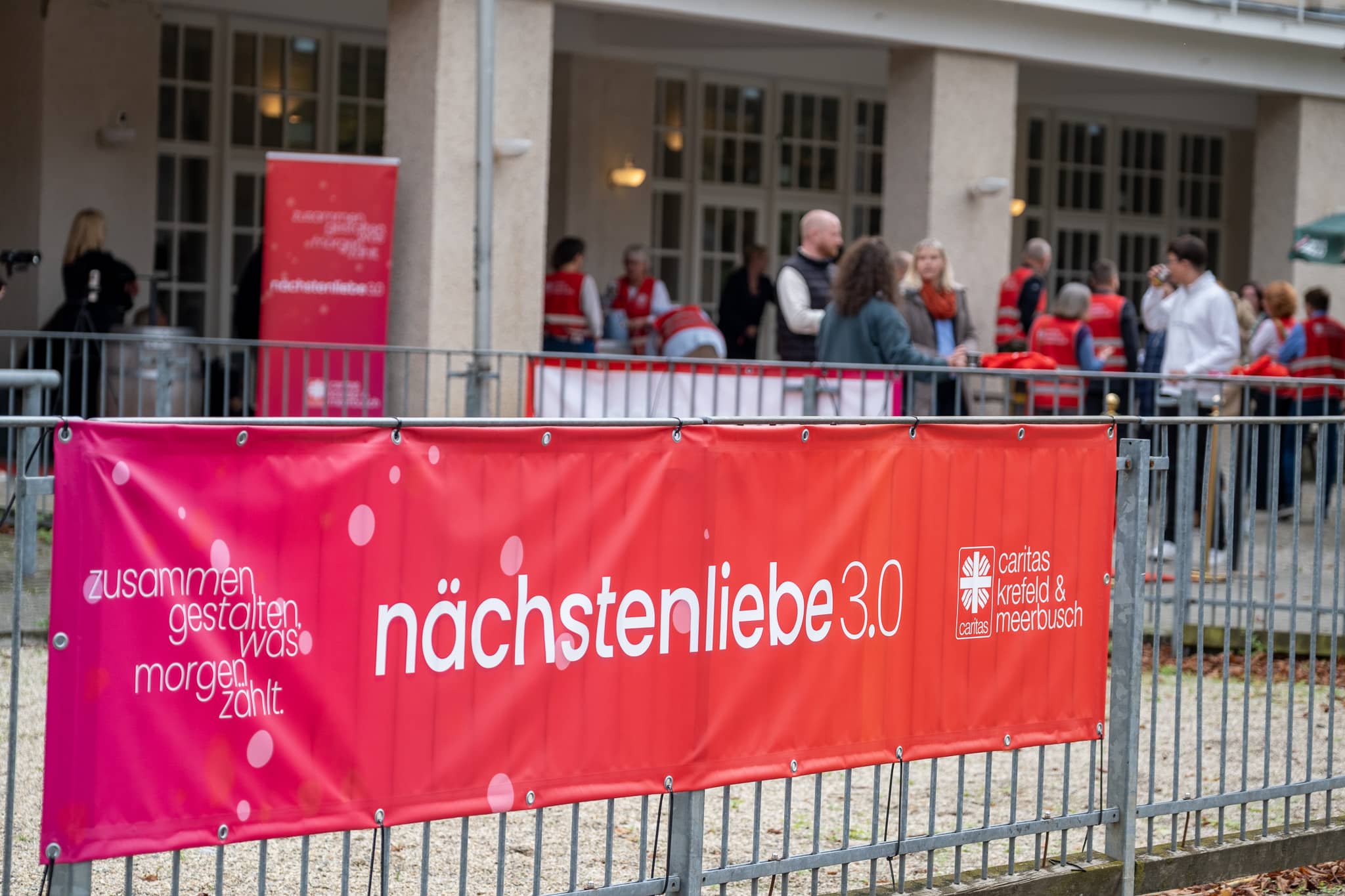
Honestly, Dana Glöß says, the leadership team, her fellow board member Delk Bagusat and herself, had had enough of strategy consultants. „Step aside, we'll handle this for you. That was exactly the attitude we didn't want.“ For her and Delk Bagusat, there was no question that Caritas für Krefeld und Meerbusch needed a clear, overarching strategy to be in the best possible shape for the future. Empty public coffers on one side, ever greater social challenges on the other: people in both cities depend on the services of independent welfare organizations. For families, children and young people, for those who are sick, elderly, struggling with addiction or newly arrived in the country, and for everyone in difficult circumstances. Here, strategy means weighing economic necessity against compassion intelligently, so there is still enough strength tomorrow to support others. „We wanted to develop a common thread that we could follow in every strategic decision,“ says Glöß. „Happy to bring in outside expertise in measured doses, but the work had to come from within the organization, with a team that shapes the process itself.“
Business language was more of an irritant
In just under a year and a half, „Nächstenliebe 3.0“ took shape: the roadmap to the future for Caritas für Krefeld und Meerbusch. That StrategyFrame® would be the tool to smooth the path there was anything but settled in early 2024. „At first there were doubts about whether a toolkit built for the private sector was even suitable for nonprofit organizations like ours,“ says the board member. Especially since the tool's business language, with its ForeSights, OKRs and ProjectPortfolios, sounds more irritating than inspiring to teams focused on social impact. And it was clear from the outset that the welfare organization would, in case of doubt, give more weight to its statutory purpose, the „commitment to help,“ than to „maximum efficiency at any price.“ Those initial reservations soon gave way to the conviction that they had chosen the right approach. „What's good about StrategyFrame® is that it sets a framework and clear guardrails. But it deliberately leaves plenty of room for individual adjustments. That way you stay at the wheel without leaving the actual path,“ says Delk Bagusat.
What no one else offers
Both still remember the first of the three workshops on working with StrategyFrame® vividly. The ten leaders from the top two levels of the hierarchy met in a children's and youth facility, right next to the foosball table and the ping-pong table. Situation analysis, target picture, fields of action: everything went on the table. The debate was especially intense around the three pillars that make up the portfolio of Caritas für Krefeld und Meerbusch. With offerings such as secondhand stores, it operates as a social enterprise that contributes a disproportionately large share of the overall result. Standard care services, for example (partially) residential and outpatient nursing care, outpatient addiction rehabilitation, assisted living and the daycare center, remain the main pillar of financial stability despite thin margins. The third pillar brings together grant- and subsidy-funded services, such as drug counseling and community work: „One thing became very clear to us in that discussion: some of our services simply don't pay off. But no one else offers them, and that's why an organization committed to compassion can't just walk away from them. We just have to earn the money for them elsewhere,“ says Dana Glöß.
„Dignity is our litmus test“
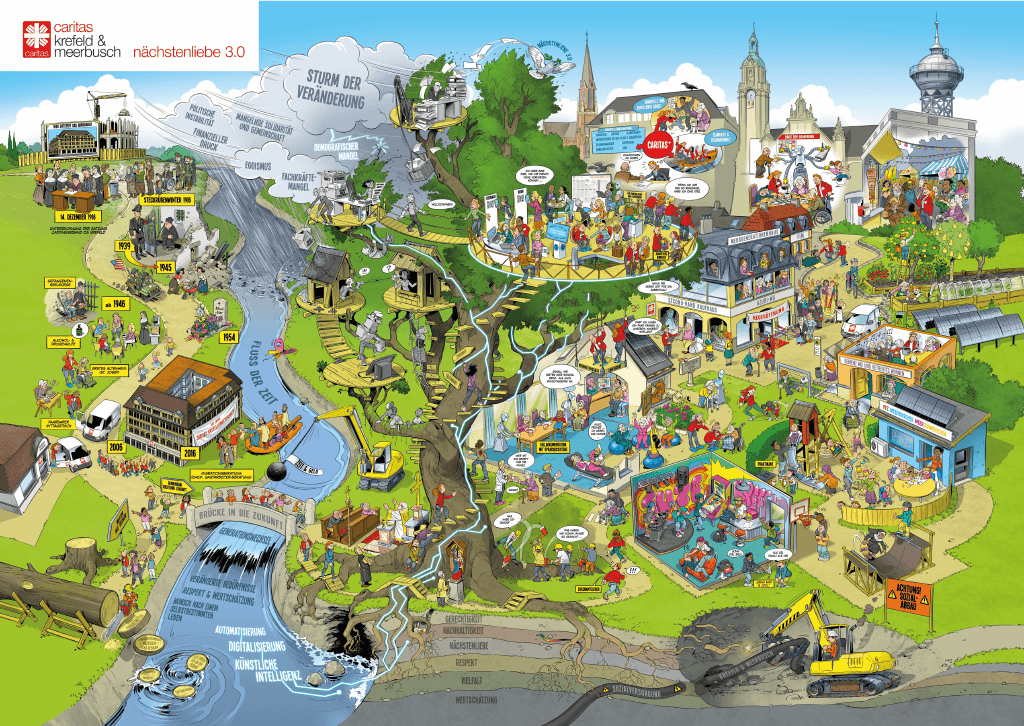
The core team met several times to align on details. Later, leaders from additional levels joined, and step by step the full strategy took shape. A key moment for Glöß and Bagusat: „The moment Christian asked us what impact we actually wanted to achieve. That really made us think.“ Answering it required a thorough examination of the history and core values of their own institution. With the positive side effect that the leadership team developed a shared understanding and a lot of trust in each other. „We bring people together. We make a dignified life possible. We open up perspectives.“ That is the impact promise that emerged in the end. „The idea of dignity in particular is central for us, it carries our Christian identity,“ Bagusat explains. „Does this offering make a dignified life possible? That's our litmus test for judging our portfolio.“ Once goals and OKRs had also been formulated together and the StrategyFrame® was filled in, the next step in the strategy process followed: translating the strategy into the „Big Picture,“ a motivating visualization that speaks to everyone in the organization.
From novel to short film
„At that point it was basically about turning a good novel into a good short film,“ Dana Glöß recalls. What was still missing were memorable images for the vision of the future. How will employees recognize that Caritas für Krefeld und Meerbusch has reached its goals? How would a resident of one of the facilities see it? How does it become tangible for the wider community? „We tackled these questions in the extended leadership team with 100 colleagues. It was an exhausting but productive day. For example, we packaged scenes into short theater pieces.“ The goal: to make clear to employees that the strategy is not a paper tiger, but a picture of the future everyone can contribute to. Instead of the classic cascade, with each leader announcing new messages to their own team, Glöß and Bagusat opted for a big splash after aligning the overall strategy with the supervisory bodies: a „Nächstenliebe 3.0“ event complete with red carpet, flags and a supporting program, to which all 1,500 employees and 300 volunteers were invited.
„We deliberately chose everyday language“
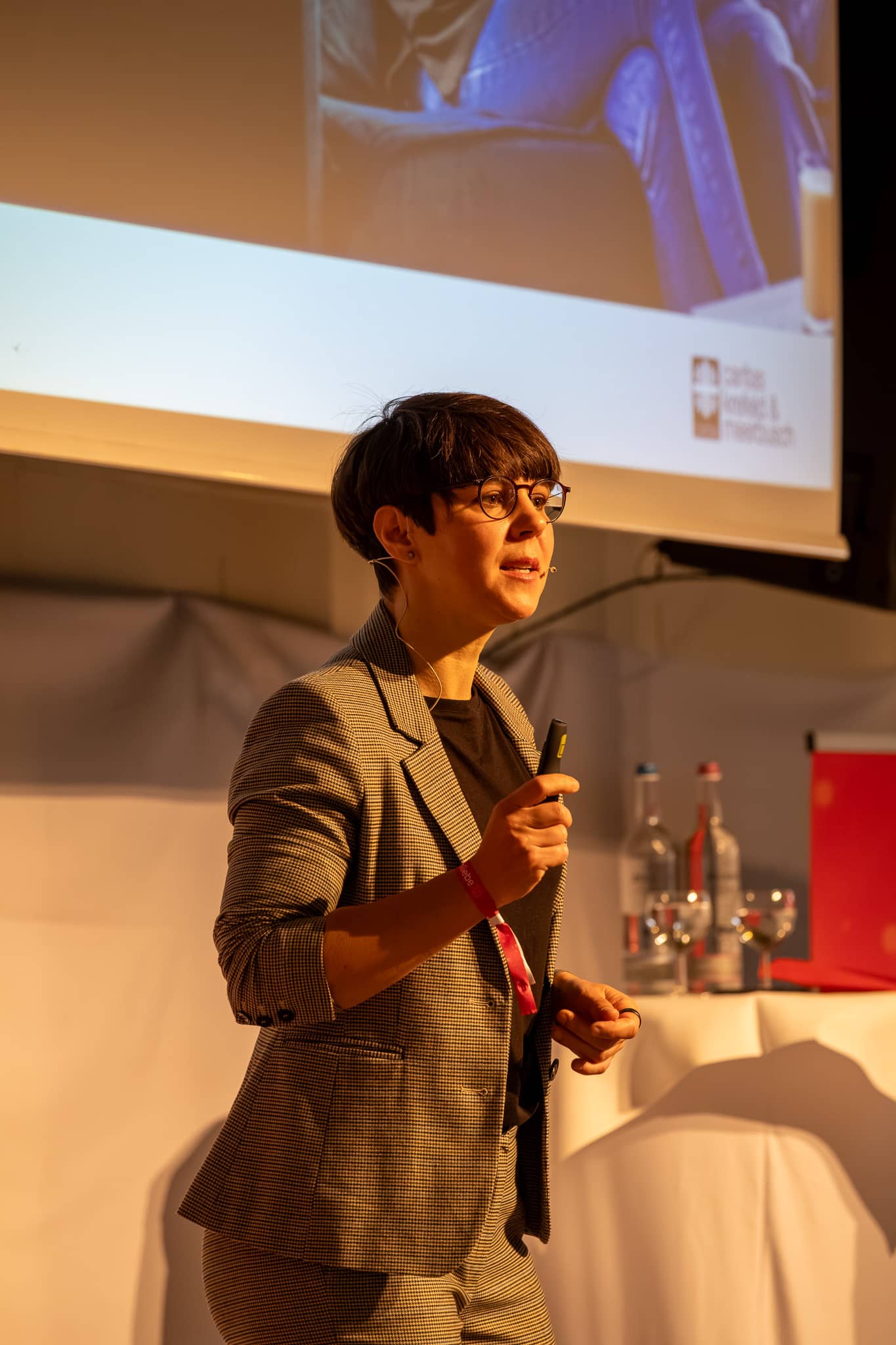
First the board spoke, then the leaders at the second and third levels explained the picture of the future to their teams. „That worked beautifully, because the leaders presented what they had developed themselves beforehand, and because we very deliberately chose clear, everyday language,“ says Glöß. The big highlight of the event: an emotional video about the identity of Caritas für Krefeld und Meerbusch, rounded off with outtakes from the production that show the board as likable, in imperfect and approachable moments. Folding cards and „Nächstenliebe 3.0“ refrigerator magnets to take home helped keep the strategy top of mind beyond that single day. What impressed Glöß and Bagusat most: the 180 questions participants sent to the board via app during and after the event. „That shows employees are really engaging with the topics, and that it has become easier to start a conversation across levels of hierarchy,“ says Bagusat. All questions have since been answered and are visible to everyone on the intranet.
Gamification and contributions from the teams
What are the next steps with „Nächstenliebe 3.0“? The wave of activation across Caritas für Krefeld und Meerbusch continues. The organization is using digital tools and gamification approaches to get employees excited about the practical relevance of the strategy and to gather further feedback. A second wave is planned for the summer of 2026. Then every team will look at where it can take action itself to move closer to the picture of the future. To support that, the OKRs that make all progress measurable will soon be firmly anchored at the third leadership level as well.
Above all, Caritas für Krefeld und Meerbusch is putting into practice what it set out to do with "Nächstenliebe 3.0." In February 2026, for example, it opened Krefeld's first non-hospital intensive care shared-living facility, closing a gap in standard care. Plans include a practice of its own offering speech, occupational and physical therapy, an early intervention center for children, possibly an opioid substitution clinic in cooperation with partners, and assisted living for people with dementia. These special housing options for seniors in particular hold a lot of potential, Glöß says, given the enormous demand. As everywhere else, Krefeld and the surrounding region lack options that sit between barrier-free housing and nursing homes. If the regional Caritas association steps up its commitment in this field, it can give people a dignified life and, entirely in line with the strategy, put the necessary financial stability on a broader footing.
The whole organization on the couch
The StrategyFrame® will be the central tool not only for keeping an overview, but for realigning "Nächstenliebe 3.0" with new challenges at any time. "Where a car manufacturer needs insight into current sales trends, our focus is more on regulatory requirements and political decisions, simply because we operate in a very specific market," Glöß says. "But we still have to aggregate metrics and draw conclusions from them." Almost more important to her, though, is what working with the StrategyFrame® has done for the culture and the way people work together: "A self-directed process like this forces you to be honest. You essentially put the entire organization, and ultimately yourself as a board member, on the couch. Tackling that so transparently and inclusively takes courage. But it pays off: everyone understands the thread we're following, and how much we need each other to make this organization fit for the future."
The BCG matrix reinterpreted
Where is it worth investing, and which business areas, offerings or projects are better left behind? The growth-share matrix developed by the Boston Consulting Group is a classic analysis tool for strategy development. The x-axis maps the dynamics of potential market growth, while the y-axis shows market share relative to the competition. Caritas für Krefeld und Meerbusch adapted the model in both language and substance for the nonprofit sector: offerings where the organization holds a fairly weak position in stagnating markets despite considerable effort are called "(poor) dogs" in the traditional matrix. "We replaced the dogs with hamsters running on a wheel," says Dana Glöß.
The "question marks," normally high-risk offerings with uncertain prospects, became "poor church mice" in the Caritas version. These are projects with enormous social impact that can never be financially viable. "Lighthouses," the Caritas counterpart to "stars," deliver on both social impact and bottom-line contribution. The fourth category, "cash cows," are "social sponsors" at Caritas für Krefeld und Meerbusch. They matter because of the stable revenue guaranteed in standard care, for instance, but in principle other providers could take them over just as easily. That is quite different from a drug consumption room or migration counseling, where often not a single other provider is available. Caritas für Krefeld und Meerbusch aims to generate at least 5% of total revenue from offerings like these, a clear commitment to its Christian identity.
A central framework, local answers
The Deutscher Caritasverband is the welfare association of the Catholic Church in Germany. The 5,300 member organizations employ 770,000 full-time staff nationwide. That makes Caritas the largest employer in the country, even compared with corporations like Volkswagen AG. Caritas facilities include daycare centers, nursing services, counseling centers, hospitals, residential homes, homeless shelters, hospices and much more. Deliberately organized as an association, the regional units in the Caritas network have plenty of room to set their own priorities within the Christian mission.
The Caritas association for the Krefeld region is one of the oldest in Germany and celebrates its 110th anniversary in 2026. Run exclusively by volunteers for many decades at first, the local association became increasingly professional after the Second World War. Today, together with Krefelder Caritasheime gGmbH, a 90% subsidiary, it provides a total of 38 services and offerings for people of all ages in Krefeld and Meerbusch.